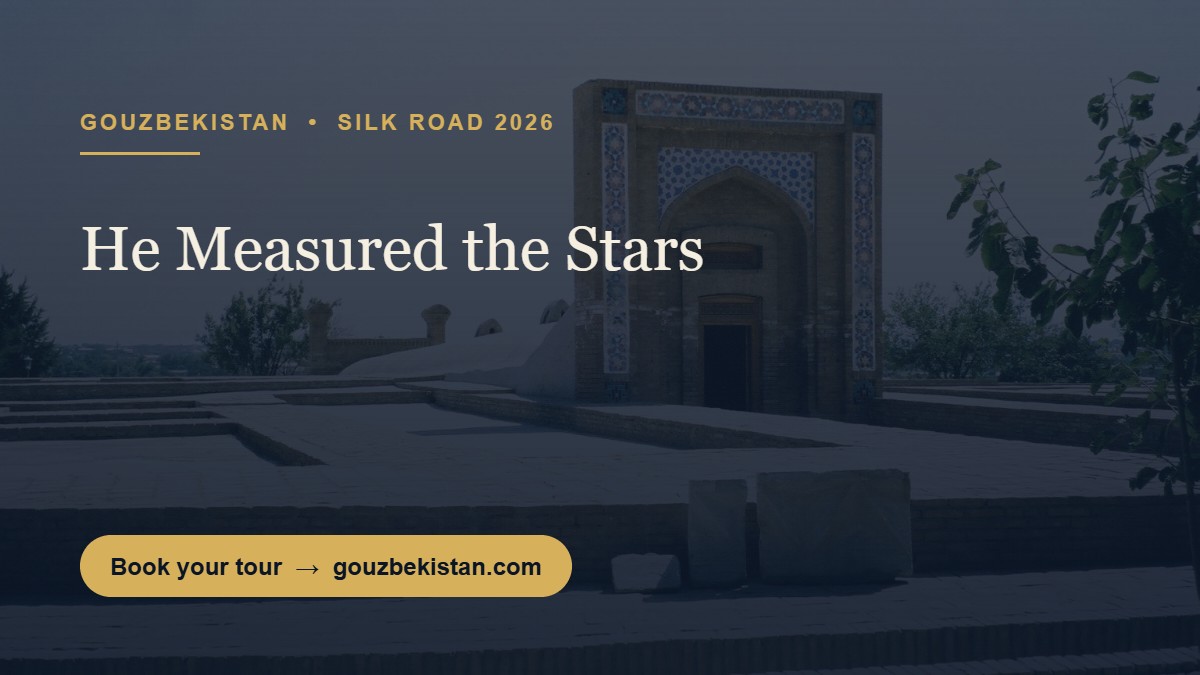
On a low hill at the northern edge of Samarkand, a curve of polished marble slides down into the earth and vanishes into the dark. Stand at the top of it and you are looking at the surviving fragment of what was, six hundred years ago, the most precise scientific instrument on the planet. The man who built it was a grandson of Tamerlane. He could have spent his life conquering things. He counted stars instead.
Most visitors give the Ulugh Beg Observatory twenty minutes between the Registan and the airport. Give it an hour, at the end of the day, when the light goes amber over the hill — and then go out into the desert and look up at the same sky he was measuring. It is, quietly, one of the most moving things Uzbekistan can offer.
The grandson of Tamerlane who chose the stars
Ulugh Beg (1394-1449) inherited Samarkand from the most feared empire-builder of his age and turned it into a university town. He built a madrasah on the Registan that still stands, taught mathematics in it, and gathered around him the finest astronomers of the Islamic world. Then, around 1420, he raised an observatory outside the city — a circular building roughly 46 metres across and some 30 metres high, faced in glazed tile and marble.
It is worth sitting with that idea for a moment. Not a fortress. Not a treasury. An observatory, built by a ruler who wanted to know where the stars actually were.
The Fakhri sextant: forty metres of marble aimed at the sky
The instrument at its heart was a Fakhri sextant with a radius of just over 40 metres — the largest of its kind ever constructed. Rather than build it upward, where wind and weight would move it, Ulugh Beg's engineers cut it downward, sinking the arc into a trench carved into the bedrock of the hill. It could not shift. That single decision is why the numbers it produced were so extraordinarily good.
The result was the Zij-i Sultani, completed in 1437: a catalogue of about 1,018 stars, measured from Samarkand, and the most significant star chart produced anywhere between Ptolemy in the second century and Tycho Brahe in the sixteenth. Ulugh Beg's team also calculated the length of the sidereal year to within under a minute of the value modern instruments give. In 1437. With marble, brass and patience.
Lost for centuries, found in 1908
The story does not end well for him. Ulugh Beg was murdered in 1449, the observatory was abandoned and stripped, and within a few generations nobody could say for certain where it had stood. It stayed lost under the hillside until 1908, when the archaeologist Vasily Vyatkin dug into the mound and struck the buried arc of the sextant, still in place, still pointing at the meridian.
That trench is what you walk down into today, alongside a small museum. There is no crowd, no queue, no theatre. Just a rail, a slope of marble, and the strange vertigo of standing inside a machine built to hold the sky still.
From the Registan to the Kyzylkum: Uzbekistan's other night sky
Here is the part most itineraries miss. Two hours north of Samarkand the irrigated valleys stop and the Kyzylkum begins, and at Lake Aydarkul there are yurt camps where the nearest streetlight is a rumour. Dinner is cooked over a fire, someone brings out a dutar, and then the fire dies down and the sky simply arrives — the Milky Way from horizon to horizon, over the same desert Ulugh Beg's observers were looking up at.
Autumn is the season for it. September days run about 22-28°C and October about 18-22°C, the air over the desert is exceptionally dry and clear, and the nights are cool without being cold. Pair it with a camel ride at dusk and a morning swim in Aydarkul, and the two nights outside the cities become the part of the trip people talk about afterwards.
Why 2026 is the year to go
Uzbekistan is in the middle of its strongest tourism year yet — the Tourism Committee projects around 12 million visitors in 2026, and the country's airports handled 8.15 million passengers in the first half of the year, some 16% above the same period in 2025. More than ninety nationalities, including the EU, the UK, the Gulf states and the United States, now enter visa-free, and Afrosiyob high-speed trains connect Tashkent, Samarkand and Bukhara in a couple of hours.
GoUzbekistan is a licensed Uzbek tour operator (licence No. 662280, Committee for Tourism Development), operated by Lochin Express Plyus LLC, with a team organising travel in this country since 2007. We time the observatory for the light, and the desert for the moon phase — because a full moon is beautiful and terrible for stargazing, and someone should be thinking about that for you.
Ready to build it? Create your own custom tour, or explore our tours across Samarkand, Bukhara, Khiva and the Kyzylkum.
Plan your Uzbekistan trip — in your language
العربية — السياحة في أوزبكستان
في سمرقند رصد أُلُغ بيك أكثر من ألف نجم عام 1437 من مرصدٍ نُحت في الصخر. زُر المرصد على طريق الحرير، ثم بِت في مخيّم يورت على بحيرة أيدركول تحت سماءٍ مليئة بالنجوم. الخريف هو أفضل موسم. صمّم رحلتك الخاصة إلى أوزبكستان.
Deutsch — Usbekistan Reise und Seidenstraße Rundreise
1437 vermaß Ulugbek in Samarkand über tausend Sterne — mit einem Sextanten, der vierzig Meter tief in den Fels gegraben war. Besuchen Sie sein Observatorium und übernachten Sie danach in einem Jurtencamp am Aydarkul-See unter einem unglaublichen Sternenhimmel. Der Herbst ist die beste Reisezeit. Entdecken Sie unsere Usbekistan-Reisen.
Español — Viajes a Uzbekistán y la Ruta de la Seda
En 1437, Ulugh Beg midió más de mil estrellas desde Samarcanda con un sextante excavado en la roca. Visita su observatorio en la Ruta de la Seda y duerme en un campamento de yurtas junto al lago Aydarkul, bajo la Vía Láctea. El otoño es la mejor época. Diseña tu viaje a medida a Uzbekistán.
Français — Voyage en Ouzbékistan sur la Route de la Soie
En 1437, Ulugh Beg mesura plus de mille étoiles depuis Samarcande, grâce à un sextant creusé à quarante mètres dans la roche. Visitez son observatoire, puis dormez sous la Voie lactée dans un campement de yourtes au bord du lac Aydarkoul. L'automne est la saison idéale. Découvrez nos circuits en Ouzbékistan.
中文 — 乌兹别克斯坦旅游 · 丝绸之路
1437年,乌鲁伯格在撒马尔罕用一台深嵌岩石、半径逾四十米的六分仪测定了一千多颗恒星。请走进他的天文台,再前往艾达尔库尔湖畔的毡房营地,在浩瀚星空下过夜。秋季是最佳出行季节。定制您的乌兹别克斯坦之旅。
Русский — Туры в Узбекистан по Шёлковому пути
В 1437 году Улугбек измерил более тысячи звёзд в Самарканде — с помощью секстанта радиусом свыше сорока метров, врезанного в скалу. Побывайте в его обсерватории, а затем проведите ночь в юрточном лагере на озере Айдаркуль под звёздным небом. Осень — лучшее время для поездки. Смотрите наши туры по Узбекистану.