Imagine hiding a whole generation of painters in a desert. Not the paintings only — the painters: their names, their canvases, the evidence that they ever worked. That is roughly what Igor Savitsky did, and the proof is still hanging on the walls of a museum in Nukus, a flat, wind-scoured town at the far western edge of Uzbekistan where almost no tour bus ever bothers to go.
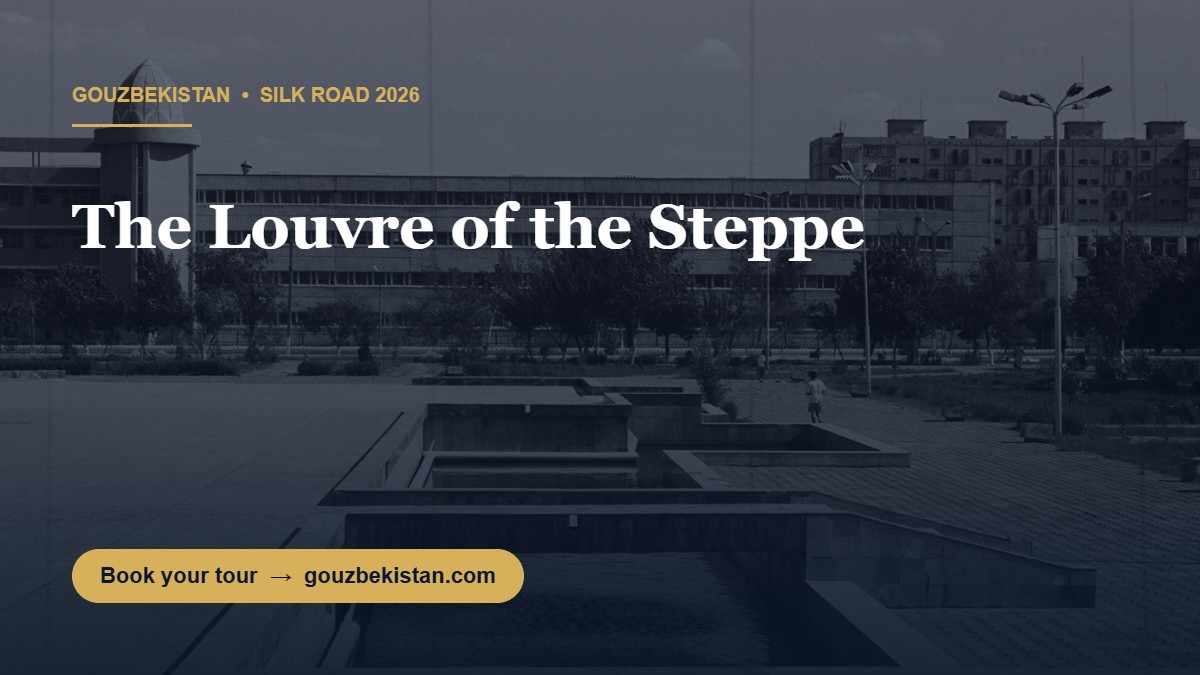
Travellers who make the detour tend to come out quiet. The New York Times and the International Herald Tribune have both described it as a must-see; the nickname that stuck is the Louvre of the Steppe. It is not a marketing phrase. It is what happens when you walk into a modest building in Karakalpakstan and find yourself standing in front of art that was supposed to have been destroyed sixty years ago.
Le musée de Noukous: the man who collected banned art
Igor Savitsky (1915–1984) was a Moscow-trained artist who came to Karakalpakstan in 1950 on an expedition and simply stayed. He fell for the place — the Karakalpak weavings, the silver, the desert light — and in 1966 he founded the State Museum of Arts of Karakalpakstan in a few borrowed rooms.
Then he did the dangerous part. Across the Soviet Union, the avant-garde of the 1920s and 30s had been condemned as formalist: artists silenced, exiled, imprisoned, in some cases shot, their work hidden in attics by frightened widows. Savitsky went looking for it. He travelled, he persuaded, he bought on credit and on promises, and he brought the canvases back to Nukus — a town so far from Moscow that nobody in the capital was paying much attention. Sometimes he used state funds to acquire art the state had banned.
By the time he died the collection ran to tens of thousands of works. It is now regarded as one of the largest holdings of Soviet-era avant-garde painting anywhere, and among them are the artists of the so-called Turkestan avant-garde — Alexander Volkov, Ural Tansykbaev, Viktor Ufimtsev — painters who took European modernism and poured Central Asian sun into it.
Art ouzbek: what you actually see on the walls
The colour is the shock. You expect grey Soviet decades and you get scorching ochres, cobalt shadows, cotton-pickers rendered in cubist planes, tea houses that look as though Matisse went east. Beside the paintings sit rooms of Karakalpak folk art — yurt textiles, silver ornaments, carved doors — and antiquities from ancient Khorezm, the desert fortresses of a civilisation older than Islam in this region.
It takes half a day, and it recalibrates everything you thought you knew about the Silk Road. This is not only a route of caravans and blue domes. It is also a place where twentieth-century Europe washed up, was forbidden, and was quietly kept alive by one stubborn man.
Route de la Soie: how Nukus fits into a real itinerary
Nukus is not a detour you make blind. It works beautifully as the western anchor of a classic route: Tashkent, then the Afrosiyob high-speed train to Samarkand and on to Bukhara, then across the Kyzylkum desert to Khiva — and from Khiva, Nukus is a straightforward drive north. Add a day and you can also stand at Moynaq, on the seabed of the vanished Aral Sea, where rusting fishing boats sit on sand a hundred kilometres from any water.
It is a hard, moving, unforgettable pairing: the art that was saved, and the sea that was not.
Getting there has never been simpler. Uzbekistan Airways flies direct between Paris Charles de Gaulle and Tashkent — under seven hours — and Uzbekistan is visa-free for citizens of more than ninety countries, including France, Belgium, Switzerland, Canada and the rest of the EU. Domestic flights and trains do the rest.
Autumn light, and why the timing matters
September to November is the season Uzbeks call Oltin Kuz, golden autumn. The Kyzylkum stops being an oven, days settle into the low twenties, and the bazaars fill with melons, pomegranates and grapes. It is the right weather for a trip that involves a lot of walking and a fair amount of driving between horizons. It is also the busiest season, so the good guides and the good hotels go early.
Built by people who live here
GoUzbekistan is the brand of Lochin Express Plyus LLC, headquartered in Bukhara and working in Uzbek tourism since 2007, under tour-operator and domestic tourism licence No. 662280 issued by the Committee for Tourism Development of the Republic of Uzbekistan. We operate on the ground with our own guides, drivers and catering teams, and we also run white-label programmes for foreign tour operators.
A Karakalpakstan extension needs planning — the distances are real and the desert is unforgiving of vague schedules. Tell us your dates and your interests and we will build it properly. Create your own custom tour, or explore our tours for ready-made Silk Road routes.
Plan your Uzbekistan trip — in your language
Français
Voyage en Ouzbékistan sur la Route de la Soie : Samarcande, Boukhara, Khiva et le musée Savitsky de Noukous, « le Louvre des steppes ». Vol direct Paris–Tachkent, entrée sans visa, et une lumière d'automne inoubliable. Composez votre voyage sur mesure avec un opérateur local agréé.
Español
Viajes a Uzbekistán por la Ruta de la Seda: Samarcanda, Bujará, Jiva y el museo Savitsky de Nukus, el «Louvre de la estepa». Entrada sin visado y vuelo directo desde Madrid. Diseña tu viaje a medida con un operador local con licencia.
العربية
السياحة في أوزبكستان على طريق الحرير: سمرقند وبخارى وخيوة، ومتحف سافيتسكي في نوكوس المعروف بـ«لوفر السهوب». دخول بدون تأشيرة ورحلات مباشرة، والخريف أفضل موسم للسفر. صمّم رحلتك الخاصة مع منظّم رحلات محلي مرخّص.
Deutsch
Usbekistan Reise auf der Seidenstraße: Samarkand, Buchara, Chiwa und das Savitsky-Museum in Nukus, das „Louvre der Steppe". Visumfrei, mit Schnellzug und goldenem Herbstlicht. Planen Sie Ihre individuelle Rundreise mit einem lizenzierten Veranstalter vor Ort.
中文
乌兹别克斯坦旅游,探访丝绸之路:撒马尔罕、布哈拉、希瓦,以及努库斯的萨维茨基博物馆——被称为"草原上的卢浮宫"。免签入境,秋季气候宜人。定制您的专属行程,由当地持牌旅行社安排。
Русский
Туры в Узбекистан по Шёлковому пути: Самарканд, Бухара, Хива и Музей Савицкого в Нукусе — «Лувр в пустыне». Золотая осень, скоростной поезд «Афросиёб» и продуманный маршрут по Каракалпакстану. Составьте индивидуальный тур с лицензированным местным туроператором.