In a low workshop in Margilan, a woman lifts a handful of silkworm cocoons out of a steaming basin, finds the loose end of a single thread with her fingertips, and begins to wind. The thread is finer than a hair and stronger than it has any right to be. Two streets away a loom is knocking out a rhythm that has not changed in centuries, and the cloth coming off it — carrying ikat’s beautiful blurred edges — will end up on a shoulder in Tashkent, or Moscow, or Paris.
Most travellers to Uzbekistan go west: Samarkand, Bukhara, Khiva. The Fergana Valley is east, over the Kamchik pass, and it is where the Silk Road stopped being history and simply carried on working.
Margilan: The Last Hand-Woven Silk in Central Asia
Margilan has been a silk town for well over a thousand years, and at the Yodgorlik workshop the whole chain still happens under one roof and by hand — cocoons reeled into thread, thread tied off in bundles for the abrbandi resist-dyeing, dye pots of pomegranate skin and walnut husk and indigo, then the loom.
That tying-off is the secret of khan-atlas and adras, the shimmering ikat cloth Uzbekistan is famous for. Because the pattern is dyed into the threads before weaving rather than printed onto finished cloth, the edge of every motif blurs very slightly. Uzbeks call it the cloth that flows like water. You can watch every stage in about ninety minutes, and you will never look at a bolt of atlas in a bazaar the same way again.
Rishtan: Blue That Comes From Ash
An hour west, the town of Rishtan sits on a seam of clay so fine that potters here have never needed to import it. What makes Rishtan ceramics instantly recognisable is the glaze: ishkor, made from the ash of mountain plants, which fires to a blue-green that no factory has ever quite copied.
The workshops are family houses with a kiln in the yard. You knock, you are handed tea, and then someone’s grandfather sits you at the wheel and lets you fail at it for a while. Plates, bowls and wide lagan platters travel home safely if a workshop packs them — and they will.
Kokand: The Palace of the Last Khan
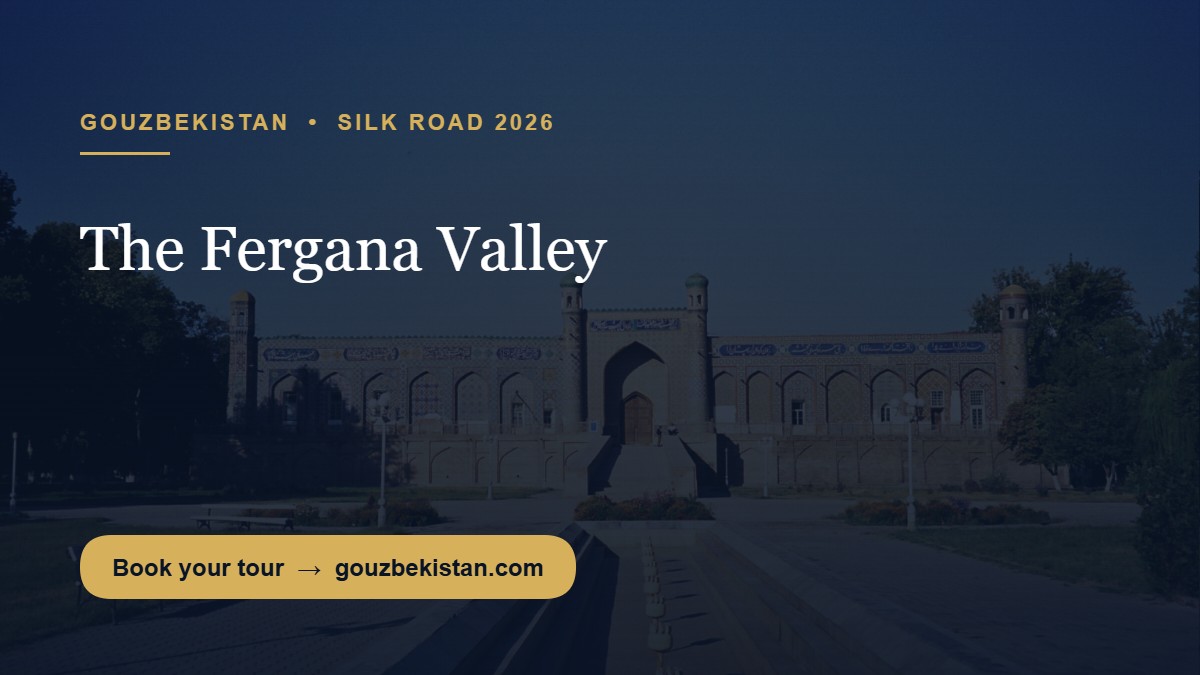
Kokand was the capital of a khanate that ruled much of the valley until the Russian Empire annexed it in the 1870s. The Khudayar Khan Palace, finished in 1873, was the last great statement of that world: a facade of glazed tile more than a hundred metres wide, built around seven courtyards and over a hundred rooms, of which only a fraction survives today as a museum.
Walk through it, then walk out into the market, where melons are stacked in pyramids and the whole valley seems to be buying bread at once. Kokand is also where the valley’s poetry lives — this was the court of Nodira, one of the great women poets of Central Asia.
When to Go, and How to Get There
Autumn is the valley’s season. From September the heat eases, the cotton and pomegranate harvests come in, the grape arbours over every courtyard hang heavy, and the plov gets serious. The road from Tashkent runs through the Kamchik pass and takes roughly four to five hours with stops for the view; there are also short flights from Tashkent to Fergana, Namangan and Andijan, and all three are now reachable on a single ticket from Abu Dhabi through the Etihad–Uzbekistan Airways codeshare launched in August 2026.
For travellers from Russia and the CIS the valley is an easy addition to a classic route: Uzbekistan is visa-free for citizens of more than ninety countries, Russian is understood in every workshop and bazaar here, and three days is genuinely enough to see Margilan, Rishtan and Kokand without rushing any of them.
Travel the Valley With People Who Live Here
GoUzbekistan is a licensed Uzbek tour operator — tour-operator licence No. 662280 from the Committee for Tourism Development — run out of Bukhara by a team that has been handling ground operations in this country since 2007. We book the workshops directly, which means you arrive when the dyers are actually dyeing rather than when the tour buses do, and we can put a Russian-, English- or Arabic-speaking guide in the car with you.
Add the Fergana Valley to a classic Silk Road route, or build a whole trip around crafts: create your own custom tour, or explore our tours.
Plan your Uzbekistan trip — in your language
العربية
السياحة في أوزبكستان لا تقتصر على سمرقند: وادي فرغانة يقدّم الحرير المنسوج يدويًا في مرغيلان والخزف الأزرق في ريشتان على طريق الحرير. رحلات خاصة مع مرشد يتحدث العربية. صمّم رحلتك إلى أوزبكستان.
Deutsch
Das Fergana-Tal ist die Werkstatt der Seidenstraße: handgewebte Seide in Margilan, blaue Keramik in Rischtan, der Khan-Palast in Kokand. Die ideale Ergänzung Ihrer Usbekistan Reise nach Samarkand und Buchara. Unsere Seidenstraße Rundreise ansehen.
Español
El valle de Ferganá completa cualquier viaje a Uzbekistán: seda tejida a mano en Marguilán, cerámica azul en Rishtan y el palacio del kan en Kokand, a pocas horas de Samarcanda por la Ruta de la Seda. Crea tu viaje a medida.
Français
La vallée de Ferghana, l’atelier vivant de la Route de la Soie : soie tissée à la main à Marguilan, céramique bleue à Richtan, palais du khan à Kokand. Un complément idéal à votre voyage en Ouzbékistan après Samarcande. Voir nos circuits.
中文
费尔干纳盆地是乌兹别克斯坦旅游中被低估的一站:马尔基兰的手工丝绸、里什坦的蓝色陶器、浩罕的汗王宫殿,丝绸之路在这里仍在运转。撒马尔罕之后值得再走三天。定制您的专属行程。
Русский
Ферганская долина — самая недооценённая часть тура в Узбекистан: ручной шёлк Маргилана, голубая керамика Риштана и дворец Худояр-хана в Коканде. Осенью здесь мягкая погода, гранаты и настоящий плов, а по-русски понимают везде. Туры в Узбекистан по Шёлковому пути.