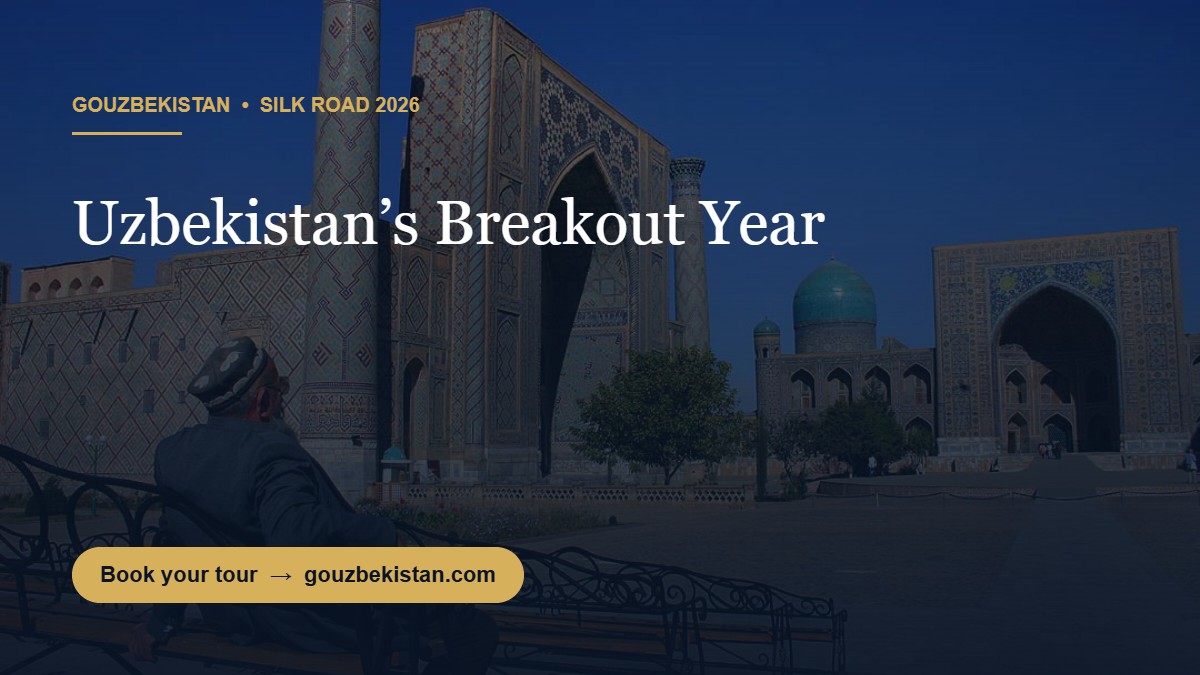
Stand in the middle of Registan Square at seven in the morning, before the coaches arrive, and the arithmetic of Uzbekistan's tourism boom feels abstract. There is only the cold blue of the tilework coming awake, a caretaker sweeping, and three madrasahs that have been staring each other down for six hundred years. Then the sun clears the eastern portal, the gold catches, and you understand exactly why 7,749,307 people got on a plane to this country in the first seven months of this year.
That figure is not a projection. It is the official count for January to July 2026 — 22.6% more foreign visitors than the same stretch of 2025, on top of a run that took Uzbekistan from 6.6 million arrivals in 2023 to 11.7 million in 2025. Tourism service exports over the same seven months reached roughly $3.9 billion, up 56% year on year. Somewhere in the last three years, a country most people could not place on a map became one of the fastest-growing destinations on earth.
Why Uzbekistan is suddenly on everyone's list
Three things happened more or less at once. The borders opened: citizens of around 90 countries — the EU, the UK, the United States, Japan, South Korea, Australia and the GCC states among them — now enter visa-free, with 30 days the standard allowance for most, and an e-visa portal covering most of the rest within a couple of working days. No invitation letter, no consulate appointment, no registration slips shoved into your passport.
The infrastructure caught up: Afrosiyob high-speed trains now connect Tashkent, Samarkand and Bukhara at 200+ km/h, turning what used to be a full day of driving into a comfortable morning. Airports handled 8.15 million passengers in the first half of 2026 alone, 16% up year on year, with international flights growing 12% and new carriers arriving through the summer.
And the country invested in the places between the monuments. More than 700 new accommodation properties opened between January and July this year, and a national programme is developing over 160 natural sites — canyons, lakes, mountain valleys — for hiking, riding and adventure travel. Uzbekistan is no longer only a cultural destination; it is becoming an outdoor one.
What the boom actually feels like on the ground
Here is the useful part: 7.7 million visitors sounds crushing until you look at where they go. A very large share are regional travellers from neighbouring Central Asian countries crossing for trade, family and short breaks. The long-haul leisure traveller is still a comparatively small slice — which is why the Registan at dawn is quiet, why you can have most of Khiva's walled Ichan-Kala to yourself before nine, and why a Bukhara silk workshop is still a workshop and not a demonstration.
What has changed is the standard of everything around the sightseeing. Boutique hotels inside restored 19th-century merchant houses. Guides with real specialisms rather than a memorised script. Restaurants doing serious Uzbek cooking instead of apologetic international menus. This is the narrow, excellent window that opens in a destination after the quality arrives and before the crowds do — and it does not stay open forever.
Uzbekistan travel in 2026: safety, cost, and the practical reality
Uzbekistan is a notably easy country to travel in. Violent crime against visitors is rare, police presence is heavy but unbothersome, and solo travellers — including solo women, who write to us about this constantly — generally report feeling safer walking Samarkand or Bukhara at night than in most European cities. Card payment is widespread in the cities, cash is still king in bazaars, and the language barrier dissolves the moment someone realises you are a guest.
Cost is the other quiet advantage. A trip that would be a splurge in Morocco or Jordan sits comfortably mid-range here: private guiding, a driver, good hotels and every entrance ticket still comes in below what the same standard costs across most of the Mediterranean. The value is not because things are cheap and rough; it is because the exchange rate is generous and the supply of good hotels has expanded faster than demand.
The best time to visit Uzbekistan — and why it is now
September and October are the finest weeks of the Uzbek calendar. Summer's heat has broken, days settle into the mid-twenties Celsius, and the harvest lands all at once: melons stacked in pyramids at the roadside, grapes, pomegranates, figs, apricots drying on flat roofs. Photographers get the low, long autumn light that makes turquoise domes do what they were designed to do. Spring, from late March to May, is its mirror image, with the added drama of snow still sitting on the mountains behind Tashkent.
The one thing worth acting on quickly is capacity. Autumn is peak season, the best small hotels in Bukhara and Khiva have fewer than twenty rooms each, and Afrosiyob seats in September sell out weeks ahead. Booking early is not an upsell here; it is simply how you get the good rooms and the good train times.
Plan it with an operator that actually lives here
GoUzbekistan has offices in Tashkent and Bukhara (Islam Karimov Street 21) and has been operating in this country since 2007. We hold tour-operator and domestic tourism licence No. 662280, issued by the Committee for Tourism Development of the Republic of Uzbekistan, and we work both directly with travellers and as a white-label ground operator for tour operators abroad. Every itinerary we build is private and custom: your pace, your interests, your number of nights per city.
The window is open. Walk through it. Create your own custom tour and we will build the route around what you actually want to see, or explore our tours to start from a ready-made Silk Road itinerary.
Plan your Uzbekistan trip — in your language
العربية — السياحة في أوزبكستان: أفضل وقت للزيارة
استقبلت أوزبكستان أكثر من ٧٫٧ مليون زائر خلال سبعة أشهر فقط من عام ٢٠٢٦، ودخول البلاد أصبح بدون تأشيرة لمواطني نحو ٩٠ دولة. سمرقند وبخارى وخيوة على طريق الحرير في انتظارك، والخريف هو الموسم الأجمل. صمّم رحلتك الخاصة إلى أوزبكستان.
Deutsch — Usbekistan Reise 2026: jetzt ist der richtige Moment
Über 7,7 Millionen Gäste in sieben Monaten, visafreie Einreise für rund 90 Länder und Hochgeschwindigkeitszüge zwischen Taschkent, Samarkand und Buchara: Die Seidenstraße war noch nie so einfach zu bereisen. Der Herbst ist die beste Reisezeit für Ihre Usbekistan Rundreise. Jetzt individuelle Reise zusammenstellen.
Español — Viajes a Uzbekistán: el mejor momento es ahora
Uzbekistán recibió más de 7,7 millones de viajeros en solo siete meses de 2026, y los ciudadanos de unos 90 países entran sin visado. Samarcanda, Bujará y Jiva te esperan en la Ruta de la Seda, y el otoño es la estación perfecta. Diseña tu viaje a medida a Uzbekistán.
Français — Voyage en Ouzbékistan : le moment idéal
Plus de 7,7 millions de visiteurs en sept mois seulement en 2026, une entrée sans visa pour près de 90 pays et des trains à grande vitesse entre Tachkent, Samarcande et Boukhara. La Route de la Soie n'a jamais été aussi accessible, et l'automne en est la plus belle saison. Créez votre voyage sur mesure en Ouzbékistan.
中文 — 乌兹别克斯坦旅游:2026 年正是最佳时机
2026 年前七个月,乌兹别克斯坦已接待超过 770 万国际游客,约 90 个国家的公民可免签入境,塔什干、撒马尔罕与布哈拉之间还有高速列车相连。丝绸之路从未如此便捷,秋季更是最美的季节。立即定制您的乌兹别克斯坦专属行程。
Русский — Туры в Узбекистан: почему ехать стоит именно сейчас
За семь месяцев 2026 года Узбекистан принял более 7,7 миллиона иностранных гостей, а граждане около 90 стран въезжают без визы. Самарканд, Бухара и Хива ждут вас на Шёлковом пути, а осень — лучшее время для поездки. Составьте свой индивидуальный тур в Узбекистан.