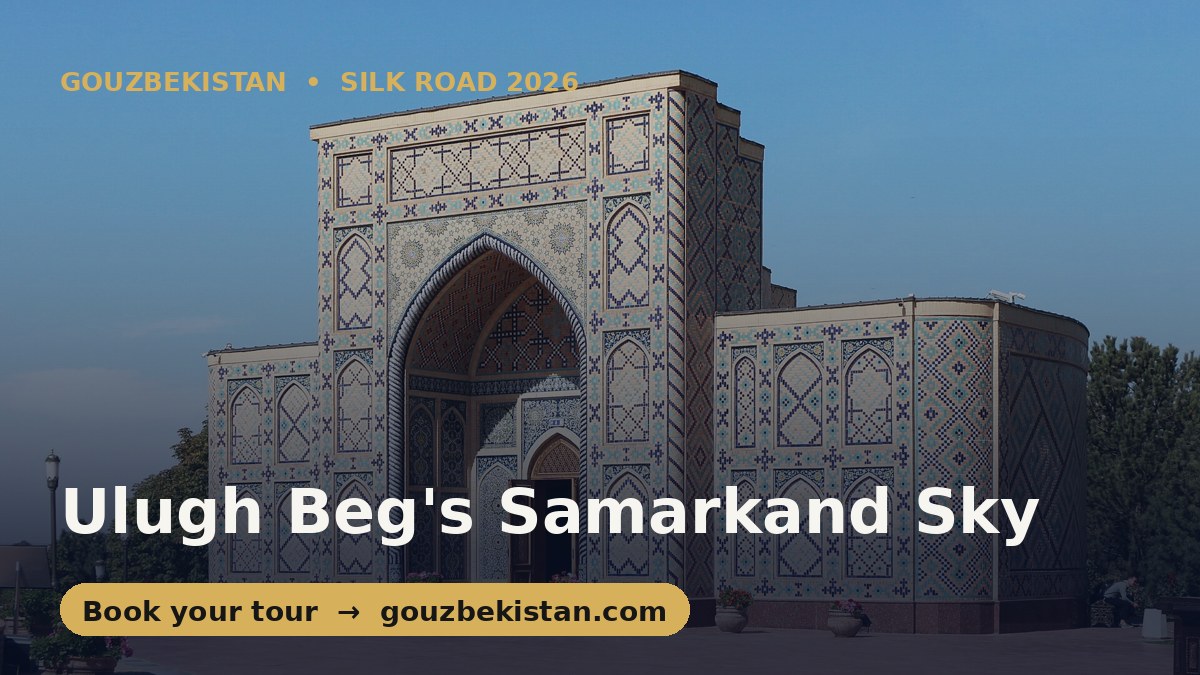
Walk up the hill on the northern edge of Samarkand at dusk, past the pomegranate stalls, and you arrive at a trench cut into the rock. It is a metre wide, lined with marble, and it curves away beneath your feet into the hillside like the groove of an enormous record. This is what remains of the instrument with which a prince of the Timurid empire measured the length of the year in 1437 — and missed by less than a minute.
Most visitors come to Samarkand for the blue. They should. But the city's most quietly astonishing story is not on a dome. It belongs to a man who inherited an empire and would rather have had a telescope, five hundred years before anyone had one.
Le prince savant: why Ulugh Beg belongs on every voyage en Ouzbékistan
Ulugh Beg was the grandson of Amir Timur — Tamerlane — the conqueror whose armies frightened half of Eurasia. The grandson was a disappointment in the family trade. He governed Samarkand from his teens, and what he built was not a fortress but a madrasa on the Registan, a mathematics faculty, and, in the 1420s, an observatory staffed by the best astronomers he could gather from across the Islamic world.
He is said to have believed that religions disperse but science endures. He was murdered for the sentiment, or near enough, in 1449, on the orders of his own son's faction. His observatory was pulled down and then, remarkably, forgotten — until 1908, when the archaeologist Vasily Vyatkin, working from a centuries-old endowment deed that named the plot of land, dug into the hillside and found the buried arc exactly where the document said it would be.
What the instrument actually did
The surviving arc is the underground portion of a colossal meridian instrument, a Fakhri sextant with a radius of roughly forty metres — the largest ever built. Sunlight entered through an aperture at the top and crossed the marble scale, and the sheer scale of the thing is the point: the bigger the arc, the finer the graduations, the more precise the angle. With it, Ulugh Beg's team produced the Zij-i Sultani, completed in 1437: a catalogue of more than a thousand stars, observed fresh rather than copied from Ptolemy, the first such undertaking in the West or the East for some thirteen centuries.
His figure for the length of the sidereal year was 365 days, 6 hours, 10 minutes and 8 seconds. The modern value is about 58 seconds shorter. His star tables reached European scholars in the seventeenth century and were printed at Oxford, at a moment when the Paris and Greenwich observatories did not yet exist.
Standing in the small museum beside the trench, looking at the reconstruction, French travellers tend to make the same connection out loud: this is a Siècle des Lumières that happened in Central Asia two hundred years early, and then was buried under a hill.
Route de la Soie in autumn: the sky is the reason to come now
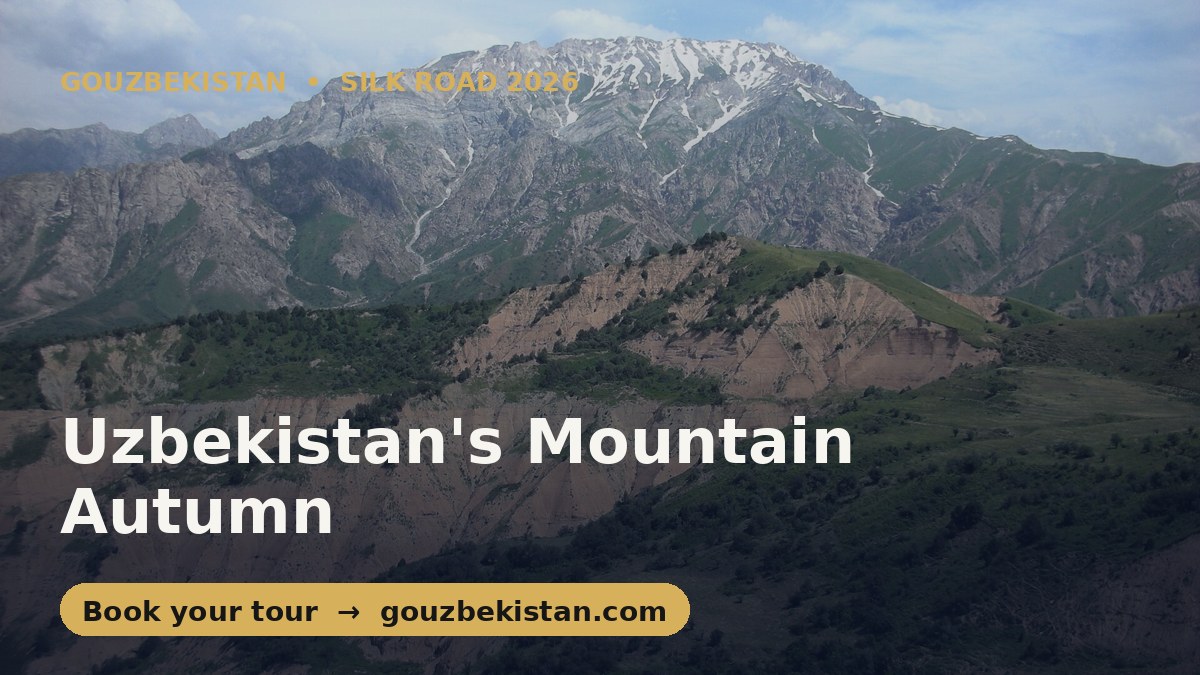
Samarkand in late September and October sits in the low-to-mid twenties Celsius by day and cools sharply after dark. The summer haze is gone, the air is dry, and the nights are the clearest of the year — which is precisely why an astronomer chose this hill. A good version of this trip pairs the observatory at golden hour with a night out in the Kyzylkum or on the shore of Lake Aydarkul, where there is no light pollution at all and the same stars Ulugh Beg numbered come out over the sand.
The practicalities are easy. Uzbekistan is visa-free for citizens of more than ninety countries, France, Belgium, Switzerland, Canada and the rest of the EU and UK among them. The high-speed Afrosiyob train puts Samarkand a little over two hours from Tashkent. Official figures reported this month show more than nine million foreign visitors in the first eight months of 2026, more than twenty percent up on last year — the country is no longer a secret, and autumn 2026 is a good moment to arrive before that fully registers.
Travelling it with a licensed operator
GoUzbekistan is the travel brand of Lochin Express Plyus LLC, a licensed Uzbek tour operator working here since 2007 (tour-operator licence No. 662280, Committee for Tourism Development, Republic of Uzbekistan). We are based in Bukhara and we build routes ourselves rather than reselling them — which for a trip like this means French-speaking guides who can handle the astronomy as well as the tilework, an observatory visit timed for the light rather than the bus schedule, and a desert night arranged around a new moon if you ask us early enough.
Ten days is the comfortable shape: Tashkent, Samarkand and its hill, the Kyzylkum, Bukhara, Khiva. Create your own custom tour with our team, or explore our tours to see what we run this autumn.
Plan your Uzbekistan trip — in your language
Français — Voyage en Ouzbékistan : Samarcande et la Route de la Soie
À Samarcande, un prince astronome a mesuré la durée de l'année en 1437 avec moins d'une minute d'erreur : son observatoire se visite toujours. L'automne offre le ciel le plus pur de l'année et des journées à 22-27 degrés. Nous créons votre voyage en Ouzbékistan sur mesure sur la Route de la Soie, avec des guides francophones. Composez votre voyage ou découvrez nos circuits.
Español — Viajes a Uzbekistán y la Ruta de la Seda
En Samarcanda, el nieto de Tamerlán midió la duración del año en 1437 con un error de menos de un minuto. Su observatorio sigue en pie, y el otoño trae el cielo más limpio del año. Organizamos viajes a Uzbekistán a medida por la Ruta de la Seda, con noches en el desierto y tren de alta velocidad. Diseñe su viaje a medida o vea nuestros circuitos.
العربية — السياحة في أوزبكستان
في سمرقند، بنى الأمير العالِم أُلُغ بيك مرصده في القرن الخامس عشر وقاس طول السنة بدقة مذهلة. الخريف يمنحك أصفى سماء في العام وطقساً معتدلاً على طريق الحرير. نحن مشغّل سياحي مرخّص ونصمّم رحلات خاصة تشمل ليلة في الصحراء. صمّم رحلتك الخاصة أو تصفّح جولاتنا.
Deutsch — Usbekistan Reise: Samarkand und die Sterne
In Samarkand vermaß ein Fürst und Astronom im Jahr 1437 die Länge des Jahres — mit weniger als einer Minute Abweichung. Sein Observatorium können Sie heute besichtigen. Der Herbst bringt den klarsten Himmel des Jahres. Unsere Seidenstraße Rundreise verbindet Samarkand, die Kysylkum-Wüste, Buchara und Chiwa. Reise individuell planen oder unsere Touren ansehen.
中文 — 乌兹别克斯坦旅游
在撒马尔罕,帖木儿之孙兀鲁伯于1437年测出一年的长度,误差不到一分钟,他的天文台至今仍可参观。秋季天空最为澄澈,气温宜人,正是丝绸之路旅行的最佳季节。我们提供定制化的乌兹别克斯坦旅游线路,含沙漠观星之夜。定制您的专属行程,或浏览我们的线路。
Русский — Туры в Узбекистан
В Самарканде внук Тамерлана в 1437 году измерил продолжительность года с ошибкой меньше минуты — его обсерваторию можно увидеть и сегодня. Осенью здесь самое чистое небо года и комфортные 22-27 градусов. Мы составляем индивидуальные туры по Шёлковому пути с ночёвкой в пустыне Кызылкум. Составить свой тур или посмотреть наши туры.