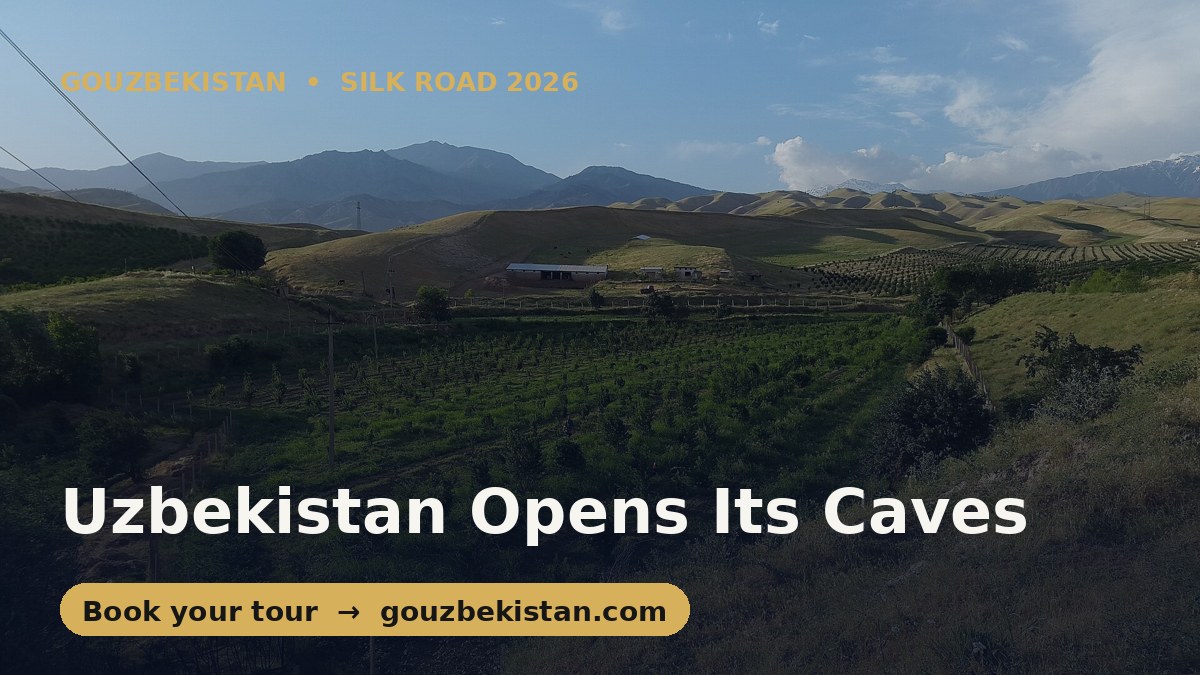
Can you visit caves in Uzbekistan? Yes, and soon far more easily: in early October 2026 Uzbekistan's government approved a programme to develop nine caves and the Khojaikon salt mine for tourism in the Jizzakh, Samarkand, Surkhandarya and Kashkadarya regions, with visitor routes, safety rules and certified guides planned through 2028.
Imagine stepping out of the dry southern heat into a gallery where the walls glitter with a crust of salt, the air is cool and still, and the only sound is a spring trickling somewhere in the dark. Then, at the end of the corridor, a balcony opens onto the mountains of Surkhandarya. For travellers who think of Uzbekistan only as turquoise domes, this is a different Silk Road: older, deeper and almost untouched.
Uzbekistan cave tourism: what the new programme includes
According to the national news agency UzA, the approved list names the Peshagor, Yakhdon, Omonquton, Kyiv, Hazrati Dovud, Qorongi Yulduz, Boybuloq, Teshiktosh and Amir Temur caves, plus the Khojaikon salt mine. Each site will be surveyed and entered into an electronic register, with digital passports, photographs, videos and 3D models, and QR codes giving visitors information on the spot. Signage, routes and safety requirements are part of the plan, coordinated with rescue services.
The Times of Central Asia reports that the Tourism Committee announced the programme on 5 October 2026, following a government resolution of 30 September. The roadmap sets April 2027 for approving tourist routes, a certification system for guides and instructors in June 2027, and January 2029 for the finished visitor infrastructure. Local families near the sites will be helped to open guesthouses, and local guides will get specialist training.
The timing fits a country in full stride: Uzbekistan welcomed 10.3 million foreign tourists in January to September 2026, 20.4% more than a year earlier, Trend reports.
Teshik-Tash: the Neanderthal cave in the mountains of Surkhandarya
For visitors from Germany, Austria and Switzerland, one name on the list carries a special echo. In 1938 archaeologists found the remains of a Neanderthal child in the Teshik-Tash cave in Surkhandarya, a discovery that, as the Smithsonian's Human Origins programme documents, placed this remote valley on the map of human evolution. The species itself is named after the Neandertal valley near Düsseldorf. Few journeys connect home and the deep past so directly: from the Rhineland to the foothills of Central Asia, following the same ancient relatives.
Nearby Boybuloq, also on the list, is a cave for specialists. The Times of Central Asia describes deep shafts and water-filled passages that make exploration technically demanding, and the Ministry of Emergency Situations is drafting the rules for visits.
Khojaikon salt cave: a salt-air retreat with a mountain view
The Khojaikon salt mine lies in the Sherabad district on the south-eastern slope of the Kugitangtau ridge, at about 1,200 metres. The official tourism portal Uzbekistan Travel describes a large salt monolith with a system of galleries, opened in 1989 and used for salt-air speleotherapy, with five separate chambers and walls covered in a one-to-three-centimetre layer of salt. Temperatures inside stay between 7 and 27°C through the year. At the end of the galleries a corridor leads to an observation deck with a panoramic view of the Surkhandarya mountains, and salt lakes lie not far away.
If you grew up with the idea of a Kur, a salt cave on the Silk Road is a wonderfully unexpected chapter in a round trip.
Planning an Uzbekistan round trip with caves, Termez and the Silk Road
The full visitor infrastructure is still a few years away, which is exactly why now is the moment for curious, early travellers. The south of Uzbekistan pairs naturally with the classic cities: Samarkand, Bukhara and Khiva on one side, the mountains and archaeology of Surkhandarya on the other. Our Hidden Gems of Uzbekistan tour is a good starting point for travellers who want to leave the main road, while the Historical Tour through Uzbekistan covers the great Silk Road cities. Because access rules for each cave are still being written, we check current conditions before adding any site to your route.
GoUzbekistan is a licensed tour operator with offices in Tashkent and Bukhara, operating since 2007. Tell us your dates and interests and we will build the journey around you: create your own custom tour or explore our tours. Questions? Write to info@gouzbekistan.com or call/WhatsApp +998 93 963-00-00.
Plan your Uzbekistan trip — in your language
العربية
السياحة في أوزبكستان تكتشف عالمًا جديدًا تحت الأرض: كهوف ومنجم ملح في جنوب البلاد إلى جانب سمرقند وبخارى على طريق الحرير. خطّط لرحلة مختلفة مع فريق محلي مرخّص. صمّم رحلتك الخاصة
Deutsch
Usbekistan Reise einmal anders: Höhlen, eine Salzgrotte und die Fundstelle eines Neandertaler-Kindes im Süden des Landes, kombiniert mit Samarkand und Buchara. Planen Sie jetzt Ihre Seidenstraße Rundreise abseits der bekannten Wege. Jetzt Reise planen
Español
Viajes a Uzbekistán más allá de las cúpulas: cuevas, una mina de sal y paisajes de montaña en el sur, junto a Samarcanda y Bujará en la Ruta de la Seda. Diseña un itinerario distinto con un operador local. Diseña tu viaje
Français
Un voyage Ouzbékistan hors des sentiers battus : grottes, mine de sel et montagnes du sud, à combiner avec Samarcande et Boukhara sur la Route de la Soie. Créez un circuit sur mesure avec une équipe locale. Créez votre voyage
中文
乌兹别克斯坦旅游新玩法:南部的溶洞、盐矿与群山,再加上丝绸之路名城撒马尔罕和布哈拉。与本地持证旅行社一起定制独特行程。定制您的行程
Русский
Туры в Узбекистан открывают подземный мир: пещеры, соляная шахта Ходжаикан и горы Сурхандарьи вместе с Самаркандом и Бухарой на Шёлковом пути. Спланируйте необычное путешествие с местным туроператором. Создайте свой тур