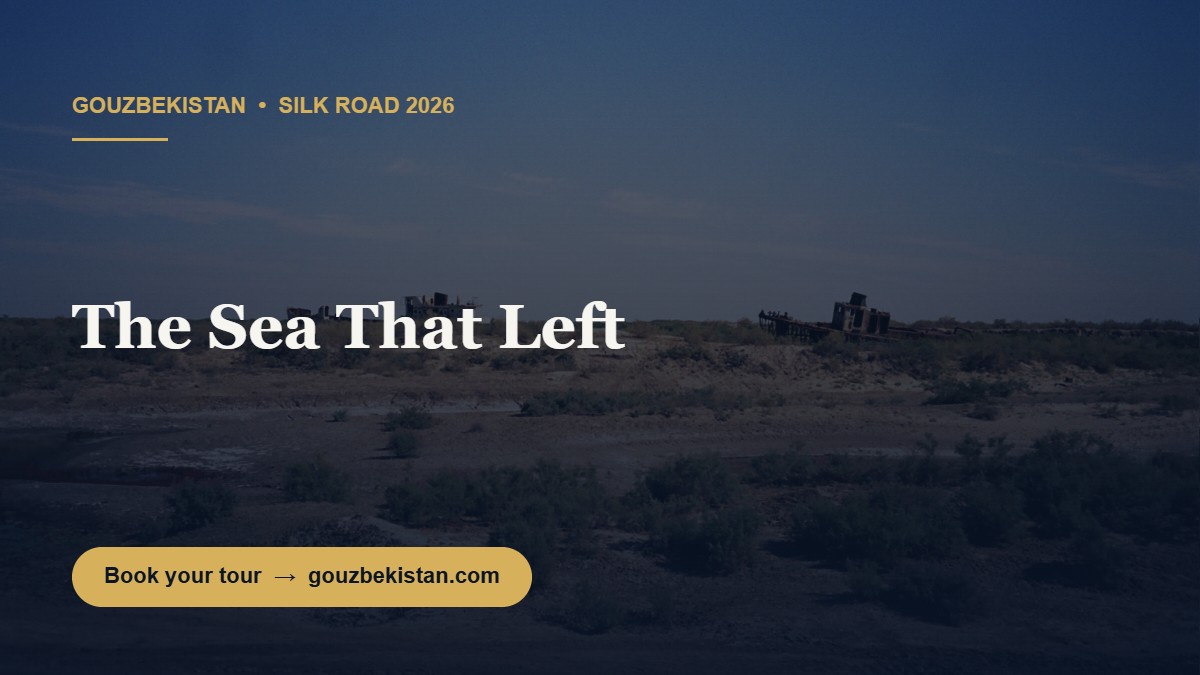
You hear it before you understand it: nothing. No gulls, no water, no engines. You are standing on the deck of a fishing trawler in Moynaq, one hand on rust warm from the sun, and in every direction there is sand — flat, pale, endless — where an inland sea used to break against this exact hull.
The Aral Sea was once the fourth-largest lake on earth. Since the 1960s it has lost more than ninety percent of its surface. The water did not rise or fall. It left.
Moynaq and the Aral Sea Ship Graveyard
Moynaq sits in the far northwest of Uzbekistan, in the autonomous Republic of Karakalpakstan. Within living memory it was a working port: a fishing fleet, a cannery, a harbour, gulls overhead, a town that smelled of salt. Today the nearest water is well over a hundred kilometres away, and a dozen or so trawlers lie tilted on the seabed below the old shoreline bluff, orange with rust, hulls open to the sky.
Above them stands the Aral Sea Museum, small and unsparing: photographs of families on a beach, of full nets, of a cinema, of a harbour that no longer exists. People still live in Moynaq. That is the part that stays with you.
Beyond the ships is the Aralkum — the Aral Sands — a desert younger than most of the people reading this, formed entirely from an exposed lakebed. Uzbekistan has been planting drought-hardy saxaul across it to bind the salt and dust in place, and the green is slowly spreading. It is one of the largest restoration efforts anywhere on the planet, and you can walk into the middle of it.
How to Visit Moynaq: The Route Through Khiva and Nukus
Moynaq is not a detour you stumble into — it is a decision. The usual approach is by road north from Khiva to Nukus (roughly four to five hours), then a further three hours or so out to Moynaq. Most travellers stay overnight, either in Moynaq itself or at a yurt camp pitched near the retreating shoreline, where the night sky over the Aralkum is as dark and as loud with stars as anywhere in Central Asia.
Nukus alone justifies the drive. The Savitsky Museum there holds one of the world's great collections of Soviet avant-garde painting — thousands of works smuggled to the edge of the empire and hidden in the desert precisely because nobody was looking. Add the ancient hilltop necropolis of Mizdakhan and the Zoroastrian tower of Chilpik, and Karakalpakstan becomes a three-day chapter, not a day trip.
Why Autumn Is the Right Season for Karakalpakstan
This is desert with a continental temper: brutal in July, bitter in January. September and October are the sweet spot — warm days, cold clear nights, low light that turns the wrecks copper at both ends of the day. It is also the season when the rest of Uzbekistan is at its best, so Moynaq slots naturally onto the end of a Silk Road route.
A ten to twelve day itinerary works beautifully: Tashkent, Samarkand and Bukhara by Afrosiyob high-speed train, then Khiva, then north into Karakalpakstan for Nukus and Moynaq. You finish where the tour buses do not go.
Travel That Actually Means Something
Plenty of destinations sell you beauty. Moynaq sells you a fact — and does it without a single interpretive panel raising its voice. Visitors leave quieter than they arrived, and the money they spend stays in one of the most economically fragile regions in Central Asia. That is about as honest as travel gets.
GoUzbekistan is the tour brand of Lochin Express Plyus LLC, operating in Uzbekistan since 2007. We hold tour-operator and domestic tourism licence No. 662280, issued 13 March 2025 by the Committee for Tourism Development of the Republic of Uzbekistan, and Travelife certification is in progress. We are based in Bukhara at Islam Karimov Street 21, we run our own vehicles, guides and ground operations, and we also work white-label for foreign tour operators.
Karakalpakstan needs planning — distances are long and infrastructure is thin. Let us build the route: create your own custom tour or explore our tours.
Plan your Uzbekistan trip — in your language
العربية — البحر الذي رحل
في مويناق ترقد سفن الصيد الصدئة على رمال بحر آرال الذي جفّ. السياحة في أوزبكستان لا تعني القباب الفيروزية في سمرقند وبخارى فحسب، بل أيضاً هذه الصحراء المذهلة على طريق الحرير. نصمّم لك رحلة خاصة. صمّم رحلتك الخاصة.
Deutsch — Das Meer, das ging
In Mo'ynoq liegen rostende Fischkutter auf dem trockenen Grund des Aralsees. Eine Usbekistan Reise im Herbst verbindet Samarkand, Buchara und Chiwa mit dieser stillen Wüste. Wir planen Ihre Seidenstraße Rundreise individuell. Reise individuell planen.
Español — El mar que se fue
En Moynaq, los barcos oxidados descansan sobre el lecho seco del mar de Aral. Los viajes a Uzbekistán en otoño combinan Samarcanda, Bujará y Jiva con este desierto silencioso de la Ruta de la Seda. Crea tu viaje a medida.
Français — La mer qui est partie
À Moynaq, des chalutiers rouillés reposent sur le fond asséché de la mer d'Aral. Un voyage en Ouzbékistan à l'automne relie Samarcande, Boukhara et Khiva à ce désert bouleversant de la Route de la Soie. Créez votre voyage sur mesure.
中文 — 消失的海
在木伊纳克,锈迹斑斑的渔船搁浅在咸海干涸的湖床上。乌兹别克斯坦旅游不只有撒马尔罕与布哈拉的蓝色穹顶,还有这片震撼人心的丝绸之路荒漠。中国公民免签入境。定制您的专属行程。
Русский — Море, которое ушло
В Муйнаке ржавые рыболовные суда стоят на дне высохшего Аральского моря. Туры в Узбекистан золотой осенью соединяют Самарканд, Бухару и Хиву с этой тихой пустыней Шёлкового пути. Создать свой тур.