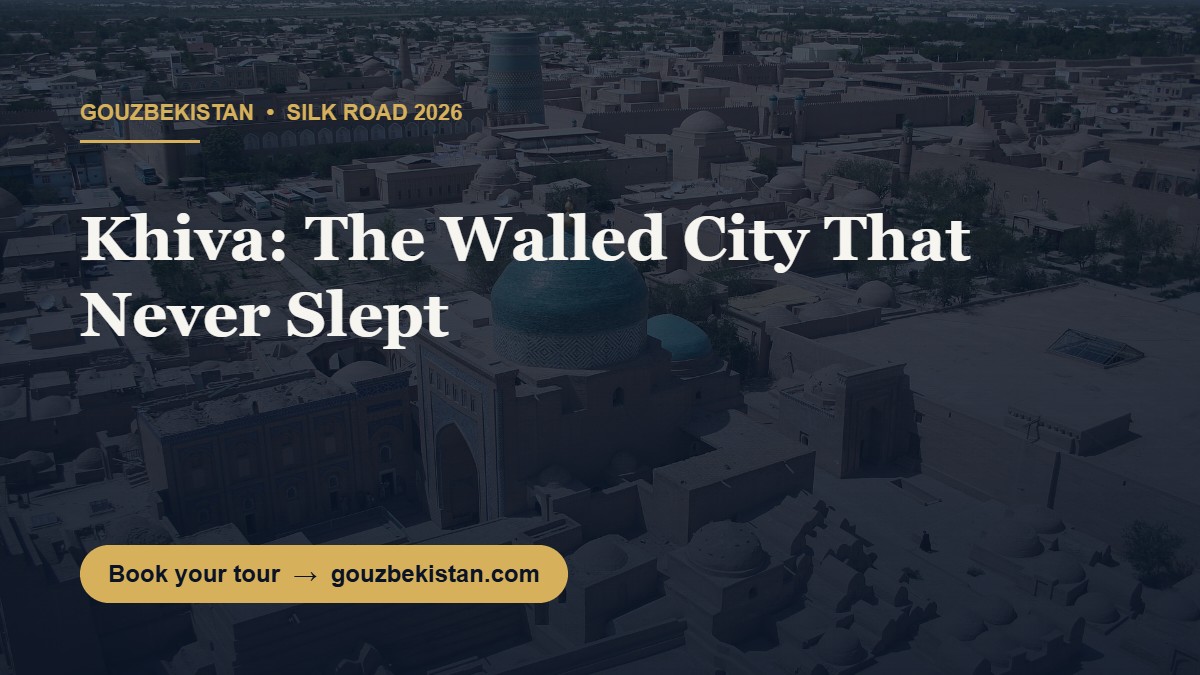
At six in the morning, Khiva belongs to nobody. The gates of the old town stand open, the souvenir stalls are still shuttered, and the only sound inside six kilometres of clay wall is a broom scraping stone somewhere behind the Juma Mosque. Then the sun clears the Kyzylkum desert and the whole city turns the colour of apricot skin - and for about twenty minutes, a complete Silk Road town belongs entirely to you.
Most travellers arrive in Khiva after lunch, walk it in three hours and leave the next morning. That is the mistake. Khiva is not a monument you tick off. It is a living walled city of roughly twenty-six hectares, and it repays anyone who stays the night.
Ichan-Kala: Uzbekistan's First UNESCO World Heritage Site
In 1990, Ichan-Kala - the inner town of Khiva - became the first site in Uzbekistan inscribed on the UNESCO World Heritage List. Inside its walls sit more than fifty protected monuments: the Kunya-Ark fortress of the Khivan khans, the Tosh-Hovli palace with its cool tiled courtyards, madrasas turned into workshops, and a mosque unlike any other in Central Asia.
The Juma Mosque has no dome and no grand portal. It is a flat roof held up by more than two hundred carved wooden columns standing in green half-darkness, a handful of them a thousand years old, each one carved by a different hand. Light falls through two openings in the ceiling and moves slowly across the floor all day. People whisper in there without being asked to.
Above the rooftops rises the Islam Khoja minaret - 56.6 metres of banded turquoise, white and dark blue majolica, built between 1908 and 1910 and still the tallest thing in Khiva. Facing it across the town stands its opposite: the Kalta Minor, the "short minaret", a vast turquoise stump begun in 1852 and abandoned three years later. It was meant to be the tallest minaret in the Islamic world. Unfinished, it became the most photographed object in Uzbekistan.
Uzbekistan Is Visa-Free for Chinese Travellers - and the Numbers Show It
Since 1 June 2025, citizens of China can enter Uzbekistan without a visa for stays of up to 30 days. The effect was immediate. In the first five months of 2026 alone, 178,121 Chinese citizens visited Uzbekistan - 78 percent more than in the same period of 2024. Direct air links between the two countries have expanded towards roughly one hundred weekly flights, served by Uzbekistan Airways, Air China, China Southern and others.
Uzbekistan is now visa-free for citizens of more than 90 countries, including the EU, the UK, the Gulf states and many more. Nationally, the country welcomed 2,872,502 foreign visitors in the first quarter of 2026 alone - a 36.6 percent increase year on year. Khiva, once the hardest of the great Silk Road cities to reach, is now the one people plan their route around.
What to Photograph in Khiva - and Exactly When
Dawn is for the walls: climb up while the town is still asleep and shoot the minarets against a pink desert sky. Late afternoon is for the Ak-Sheikh Bobo bastion inside the Kunya-Ark, where the whole of Ichan-Kala lays itself out below you and the Kalta Minor glows. Blue hour, just after the floodlights come on, is when Khiva looks least like a museum and most like a story.
In between, go to the workshops. Khivan wood-carvers still cut walnut columns by hand; suzani embroiderers work in the old madrasa cells; and the flat bread comes out of clay tandyrs in the residential lanes behind the main axis, where almost no visitor walks. Buy the bread. It is the best souvenir in the city and it costs almost nothing.
How to Reach Khiva and How Long to Stay
Urgench international airport sits about 35 kilometres from the old town, and a direct rail service now links Tashkent through Bukhara to Khiva, so the city no longer needs to be an add-on. Give it two nights, not one - one for the sunset, one for the sunrise. Then continue along the classic Silk Road line: Khiva, Bukhara, Samarkand, Tashkent.
GoUzbekistan is a licensed Uzbek tour operator (licence No. 662280, Committee for Tourism Development) operating since 2007, with our own team on the ground in Bukhara. We build private itineraries with English, Russian, Chinese and Arabic-speaking guides, comfortable transport and hand-picked boutique stays inside the old towns - not on the ring road. Create your own custom tour or explore our tours and let us hold the dawn slot in Khiva for you.
Plan your Uzbekistan trip - in your language
中文 - 乌兹别克斯坦旅游 · 丝绸之路 · 撒马尔罕
希瓦古城是丝绸之路上保存最完整的城墙古城,也是乌兹别克斯坦第一处世界文化遗产。自2025年6月起,中国公民可免签停留30天。与持牌地接社一起游览希瓦、布哈拉与撒马尔罕。查看我们的线路,或定制专属行程。
العربية - السياحة في أوزبكستان
خيوة مدينة مسوَّرة على طريق الحرير، وأول موقع أوزبكي يُدرج في قائمة اليونسكو للتراث العالمي. تجوّل بين المآذن الفيروزية في خيوة وبخارى وسمرقند مع منظّم رحلات مرخَّص داخل أوزبكستان. اكتشف جولاتنا أو صمّم رحلتك الخاصة.
Deutsch - Usbekistan Reise und Seidenstraße Rundreise
Chiwa ist eine vollständig erhaltene Stadt hinter einer Lehmmauer - und Usbekistans erste UNESCO-Welterbestätte. Verbinden Sie Chiwa mit Buchara und Samarkand auf einer Seidenstraßen-Rundreise mit deutschsprachiger Reiseleitung. Unsere Reisen entdecken oder Ihre eigene Rundreise planen.
Español - Viajes a Uzbekistán y la Ruta de la Seda
Jiva es una ciudad amurallada de la Ruta de la Seda y el primer sitio de Uzbekistán inscrito en la lista del Patrimonio Mundial de la UNESCO. Recorra Jiva, Bujará y Samarcanda con un operador local con licencia y guías en español. Ver nuestros circuitos o diseñar su viaje a medida.
Français - Voyage en Ouzbékistan sur la Route de la Soie
Khiva est une cité fortifiée entièrement préservée, premier site ouzbek inscrit au patrimoine mondial de l'UNESCO. Associez Khiva, Boukhara et Samarcande lors d'un voyage sur la Route de la Soie, avec guide francophone. Découvrir nos circuits ou créer votre voyage sur mesure.
Русский - Туры в Узбекистан по Шёлковому пути
Хива - это целый город внутри глиняной стены и первый объект Узбекистана в списке всемирного наследия ЮНЕСКО. Соедините Хиву, Бухару и Самарканд в одном маршруте по Шёлковому пути с русскоязычным гидом. Смотреть наши туры или составить свой маршрут.