Where is Timur (Tamerlane) buried? Timur lies in the Gur-e-Amir mausoleum in Samarkand, Uzbekistan — a ribbed turquoise-domed tomb begun in 1403 that became the family crypt of the Timurid dynasty, resting place of Timur, his sons and grandsons, including the astronomer-king Ulugh Beg. It stands within Samarkand's historic centre, inscribed on UNESCO's World Heritage List in 2001.
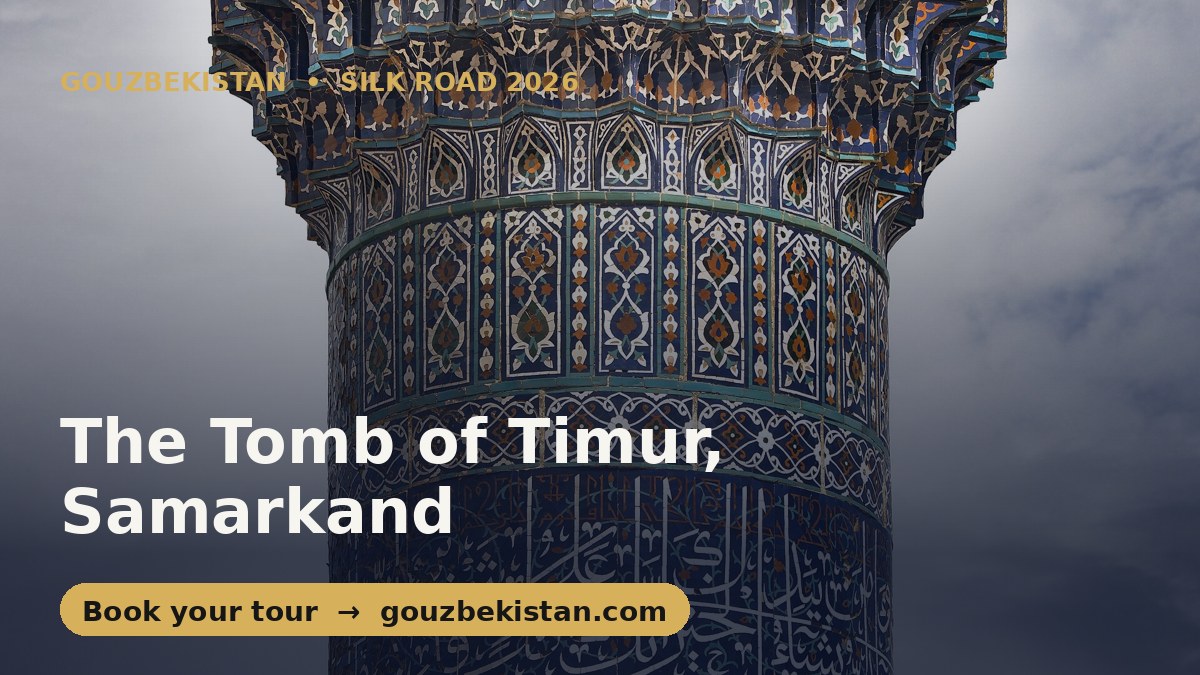
Step through the portal and the noise of the city falls away. Above you, the dome is covered in light and dark blue glazed brick; inside, gold, onyx and marble glow in the half-light, and carved rosettes on the vault imitate a starry sky. It is a place built for silence — and yet it holds one of the most dramatic stories of the twentieth century.
Gur-e-Amir, Samarkand: the tomb of a conqueror
Timur, who ruled from 1369 to 1405, rebuilt Samarkand as the capital of an empire that stretched across Central Asia and beyond. He died unexpectedly in the winter of 1405 while on campaign; with the mountain passes to his birthplace Shahrisabz closed by snow, he was laid to rest in Samarkand instead. Work on the mausoleum had begun in 1403, and it was his grandson Ulugh Beg who completed the complex and turned it into the dynasty's family crypt.
Timur lies beside his grandson Muhammad Sultan. Around him, over the years, came the graves of his spiritual adviser Sayyid Baraka, his son Shah Rukh — second ruler of the Timurid Empire — and Ulugh Beg himself. The tombstones you see in the main hall are memorials; the actual graves lie in a crypt beneath the floor.
The Curse of Timur: legend and history
In June 1941 a Soviet expedition led by the anthropologist Mikhail Gerasimov opened the crypt to study Timur's remains. The team included leading Central Asian scholars, among them the writer Sadriddin Ayni, as well as a film crew. Gerasimov's work confirmed injuries Timur had suffered in life and showed that Ulugh Beg had been beheaded; he later reconstructed Timur's face from the skull.
Then came the legend. Accounts agree that before the tomb was opened, three old men approached the team at a teahouse with a manuscript warning of a curse. The coffin was opened around 20 June 1941; on 22 June, Nazi Germany invaded the Soviet Union. Popular retellings claim an inscription promised that whoever opened the tomb would unleash an invader worse than Timur. Historians note that no such curse is carved there: the coffin bears a simple Islamic prayer, and the famous jade slab lists Timur's ancestors. Still, the story took on a life of its own — Timur was reburied with Islamic rites in November 1942, and some versions link the reburial to the turning point at Stalingrad weeks later.
True or not, the tale is part of why travellers from every continent come here. Standing before the dark jade stone, it is impossible not to feel the weight of six centuries.
How to visit Gur-e-Amir and Samarkand
Gur-e-Amir sits a short walk from the Registan, so it is easy to fit into a first day in Samarkand. Combine it with Shah-i-Zinda, the Bibi-Khanym Mosque and Ulugh Beg's observatory to follow the Timurid story from beginning to end. Our Samarkand 3-day tour covers these highlights at an unhurried pace, while the historical tour through Uzbekistan continues to Bukhara and Shahrisabz — the birthplace where Timur had once planned to be buried. For a comfortable base in the city, consider the Hilton Garden Inn Samarkand.
Autumn and early winter bring mild days and fewer crowds — ideal for slow visits and good photographs. Citizens of around 90 countries can enter Uzbekistan visa-free.
Explore the Timurid Silk Road with a local team
GoUzbekistan is a licensed tour operator with offices in Tashkent and Bukhara, operating since 2007. We can build a Timurid-themed route with an expert guide who brings these stories to life, rail connections between the cities and hotels to match your style. Create your own custom tour or explore our tours — and stand where the world's most famous "curse" was born. Questions? WhatsApp +998 93 963-00-00 or info@gouzbekistan.com.
Plan your Uzbekistan trip — in your language
العربية
السياحة في أوزبكستان: زُر ضريح كور أمير في سمرقند، مثوى تيمور وحفيده أولوغ بيك، وأحد أجمل معالم طريق الحرير. مواطنو نحو 90 دولة يدخلون دون تأشيرة. صمّم رحلتك الخاصة
Deutsch
Ihre Usbekistan Reise zum Grab Timurs: das Gur-Emir-Mausoleum in Samarkand, Legende vom „Fluch des Tamerlan“ und Juwel jeder Seidenstraße Rundreise. Bis zu 30 Tage visumfrei für Deutsche, Österreicher und Schweizer. Jetzt Reise planen
Español
Viajes a Uzbekistán: descubre el mausoleo Gur-e-Amir en Samarcanda, la tumba de Tamerlán y escenario de la famosa «maldición» de 1941, una joya de la Ruta de la Seda. Diseña tu viaje
Français
Un voyage Ouzbékistan au cœur de l'histoire : le mausolée Gour-Emir à Samarcande, tombeau de Tamerlan et de son petit-fils Ouloug Beg, sur la Route de la Soie. Créez votre voyage
中文
乌兹别克斯坦旅游必访:撒马尔罕的古尔-埃米尔陵墓,帖木儿及其孙兀鲁伯长眠之地,丝绸之路上最动人的传奇之一。定制您的行程
Русский
Туры в Узбекистан: мавзолей Гур-Эмир в Самарканде — усыпальница Тамерлана и Улугбека, легенда о «проклятии» 1941 года и жемчужина Шёлкового пути. Создайте свой тур