Stand on the bank of the Amu Darya as the sun goes down and the river turns the colour of hammered bronze — wide, slow, unhurried, with the mountains of Afghanistan smudged blue on the far shore. Two thousand years ago this crossing was one of the busiest places on earth, and the men who walked it in ochre robes were carrying something heavier than silk: they were carrying Buddhism out of India and towards China.
Almost every traveller meets Uzbekistan through the turquoise domes of Samarkand and Bukhara. Almost nobody goes south. This autumn, that is the mistake worth correcting — because the country’s deep south, the Surkhandarya oasis around Termez, is the one place on the Silk Road where you can stand inside a Buddhist monastery and hear the call to prayer at the same time.
Termez: the Silk Road city that was Buddhist long before it was Islamic
Termez is one of the oldest continuously inhabited cities in Central Asia, with roughly 2,500 years of history layered under the cotton fields. Under the Kushan Empire it was a Buddhist capital, and its monasteries are still here.
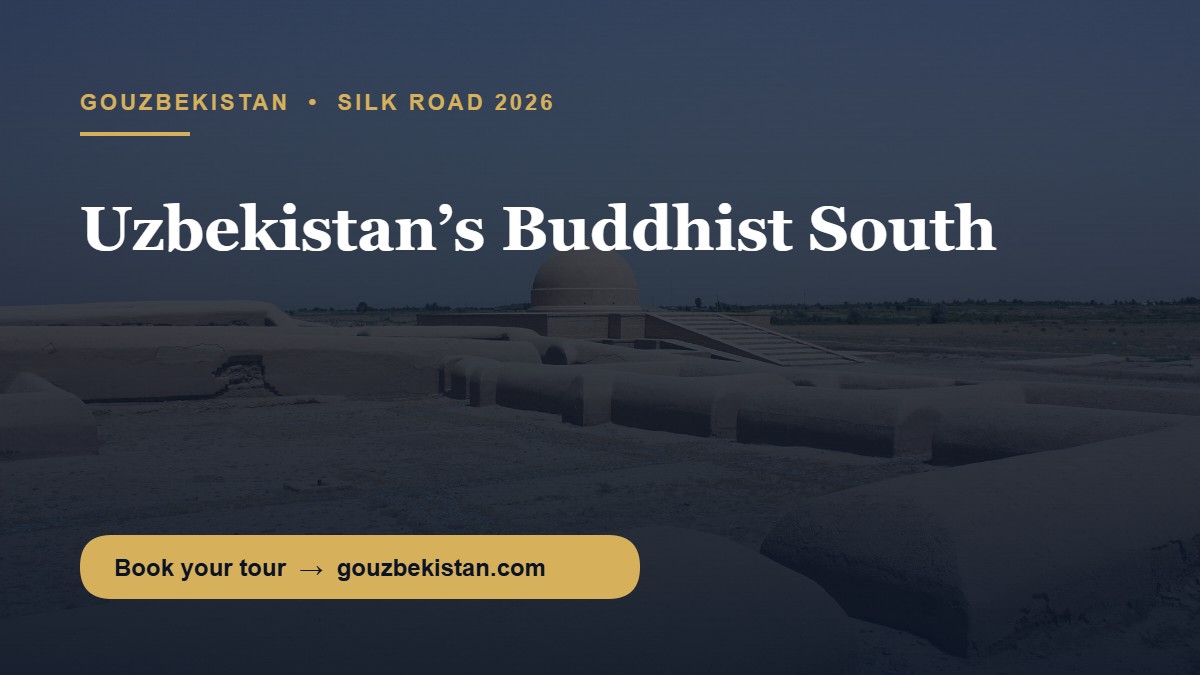
At Fayaz Tepa — known in Sanskrit as Haya Vihara, the Monastery of the Horsemen — you walk the outline of a complex some 140 metres long where around a hundred monks once lived, studied and slept. A few hundred metres away, Kara Tepa is stranger still: cells and shrines cut straight into the soft sandstone hills, cool and dim even at midday. And out in the fields stands Zurmala, a lone weathered brick tower, the country’s oldest surviving Buddhist stupa, with nothing around it but cotton and sky.
Then the story turns. A short drive away, the Sultan Saodat memorial complex lines up its cool brick portals like a corridor of centuries, and pilgrims still come to the mausoleum of Al-Hakim at-Termizi, the ninth-century Sufi master whose name the city carries. The Archaeological Museum of Termez holds it all in one room: Buddhist statuary, Hellenistic coins, Kushan-era jewellery, Bronze Age pottery.
Why autumn is the only sensible season for a southern Uzbekistan tour
Surkhandarya is the hottest corner of the country. In July the air stops moving and the thermometer climbs past 45°C. From late September the whole region exhales: days settle into the mid-20s, evenings need a light jacket, and the light goes long and gold across the ruins — the hour photographers travel for.
It is also harvest. The south’s pomegranates ripen and split, melons stack up in pyramids at the roadside, and every table you sit at is heavier than the last. Golden autumn — Oltin Kuz — is not a marketing phrase here. It is the season Uzbeks themselves wait for all year.
One hour from Tashkent: the easiest hard-to-reach place in Central Asia
Termez sounds remote, and then you look at the timetable. Domestic flights from Tashkent take a little over an hour and run several times a week; the overnight train is the romantic alternative, rolling south while you sleep. Entry is simple, too — Uzbekistan is visa-free for citizens of more than 90 countries, including the EU, the UK, Switzerland, the Gulf states and Japan, and US passport holders gained 30-day visa-free entry in 2026.
In practice, the south is best travelled as three or four days bolted onto a classic route: Tashkent, Samarkand, Bukhara, Khiva — then the flight to Termez, when everyone else is going home. That is exactly the kind of itinerary we build.
Travel the south with a licensed local operator
GoUzbekistan is the brand of Lochin Express Plyus LLC, a Tashkent- and Bukhara-based company operating in Uzbek tourism since 2007 and holding tour-operator licence No. 662280 from the Committee for Tourism Development of the Republic of Uzbekistan. We are a full ground operator: our own guides, our own transport, our own catering teams, and Travelife certification in progress. When your driver knows which gate at Kara Tepa the custodian opens early, that is 18 years of local operating, not luck.
Tell us how you like to travel — slow and archaeological, or a two-week Silk Road arc with the south as its final surprise — and we will build it around you. Create your own custom tour, or explore our tours to see where to start. Autumn dates in the south fill early; the good local guides in Surkhandarya are a small circle.
Plan your Uzbekistan trip — in your language
العربية
السياحة في أوزبكستان لا تقتصر على سمرقند. في ترمذ، جنوب البلاد، تنتظرك أديرة بوذية عمرها ألفا عام على ضفاف نهر آمو داريا، على بعد ساعة طيران واحدة من طشقند. الخريف هو أفضل موسم لرحلة على طريق الحرير. صمّم رحلتك الخاصة مع خبراء محليين.
Deutsch
Eine Usbekistan Reise endet nicht in Samarkand. Im Süden, in Termez, stehen buddhistische Klosterruinen aus der Kuschan-Zeit direkt am Amudarja — nur eine Flugstunde von Taschkent entfernt. Die perfekte Verlängerung Ihrer Seidenstraße Rundreise im goldenen Herbst. Unsere Reisen ansehen oder Ihre Reise individuell planen.
Español
Los viajes a Uzbekistán suelen terminar en Samarcanda, pero el sur guarda monasterios budistas de hace dos mil años junto al río Amu Daria, a una hora de vuelo de Taskent. El otoño es la mejor época para recorrer la Ruta de la Seda. Diseña tu viaje a medida.
Français
Un voyage en Ouzbékistan ne s’arrête pas à Samarcande. Au sud, à Termez, des monastères bouddhiques vieux de deux mille ans veillent sur l’Amou-Daria, à une heure d’avion de Tachkent. L’automne est la saison idéale pour la Route de la Soie. Découvrez nos circuits.
中文
乌兹别克斯坦旅游不只有撒马尔罕。南部的铁尔梅兹保存着两千年前的佛教寺院遗址,就在阿姆河畔,从塔什干飞行仅需一小时。秋季是走丝绸之路的最佳季节。定制您的专属行程。
Русский
Туры в Узбекистан обычно заканчиваются в Самарканде — а на юге, в Термезе, сохранились буддийские монастыри возрастом две тысячи лет на берегу Амударьи. Осень — лучшее время для путешествия по Шёлковому пути. Смотреть туры.