In the autumn of 627 a young monk slipped out of Chang'an at night, without imperial permission, and walked west into the dark. He had no escort, no travel papers and no map worth the name — only a question about the Buddhist scriptures that nobody in China could answer for him. Three years later Xuanzang stood before a walled city on the Zarafshan River, looked at its orchards, its water channels and its endlessly bargaining merchants, and wrote that it was a great capital, ruled by a king whom the neighbouring lands obeyed.
That city was Samarkand. It is still there. And for the first time in thirteen centuries, a traveller from Xi'an can stand where he stood — after a single flight, with no visa in their passport.
The Silk Road city Xuanzang called a great capital
Xuanzang's journey took him from 627 to 645, and the record he dictated on his return — the Great Tang Records of the Western Regions, completed in 646 — remains one of the most precise eyewitness accounts of the Silk Road that survives anywhere. In it he describes more than a hundred kingdoms: their crops, their laws, their temples, the character of their people. Archaeologists across Central Asia still open that book before they open the ground.
He passed through Chach, the oasis that is now Tashkent. He crossed the Hungry Steppe into Sogdiana. He described Samarkand as a place of extraordinary wealth where merchants from every direction met — and he was right in a way he could not have known, because when Soviet workmen cut a road through the old city mound of Afrasiab in 1965, they exposed a seventh-century palace wall painted with foreign ambassadors: Korean envoys with feathered caps, Chinese figures on a river, Turkic guards. Those murals were painted within a generation of Xuanzang's visit. You can look at them today in the Afrasiab Museum, ten minutes from the Registan.
Samarkand tours for Chinese travellers: what the monk saw, and what came after
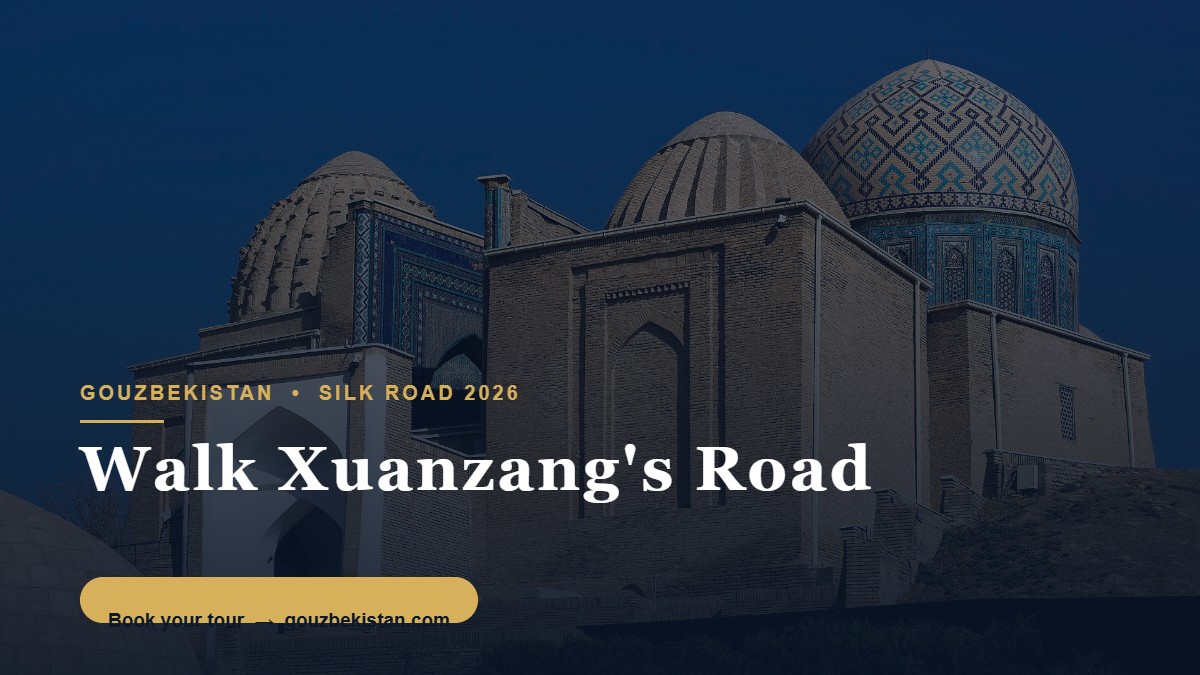
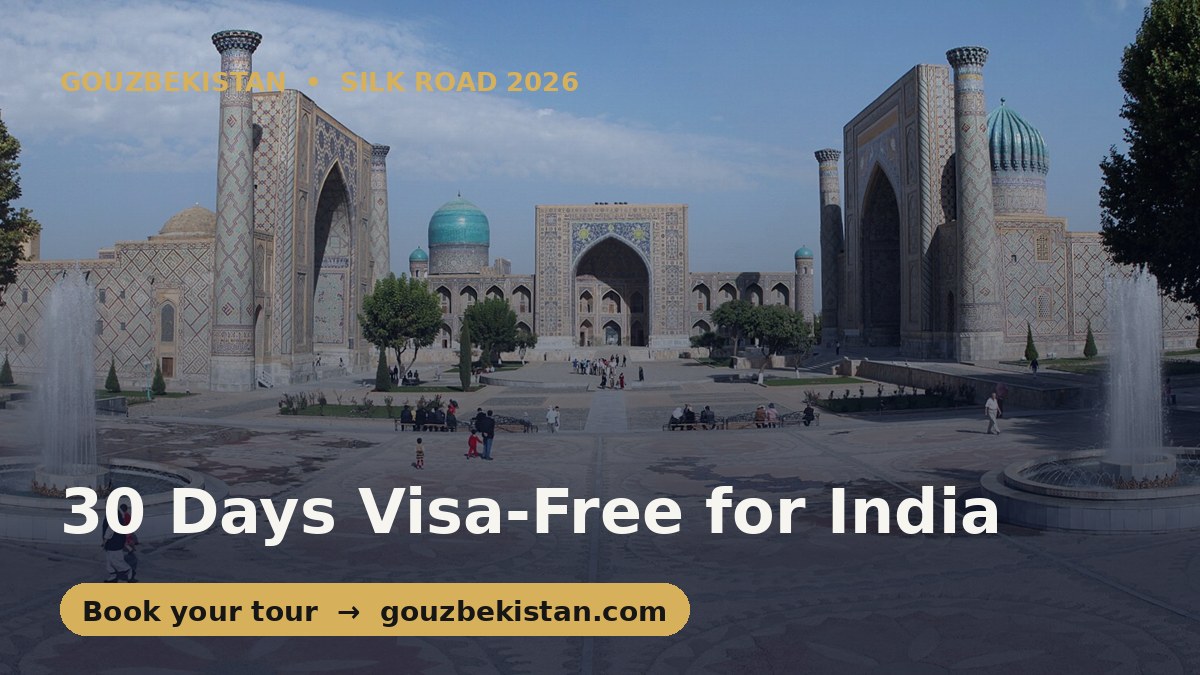
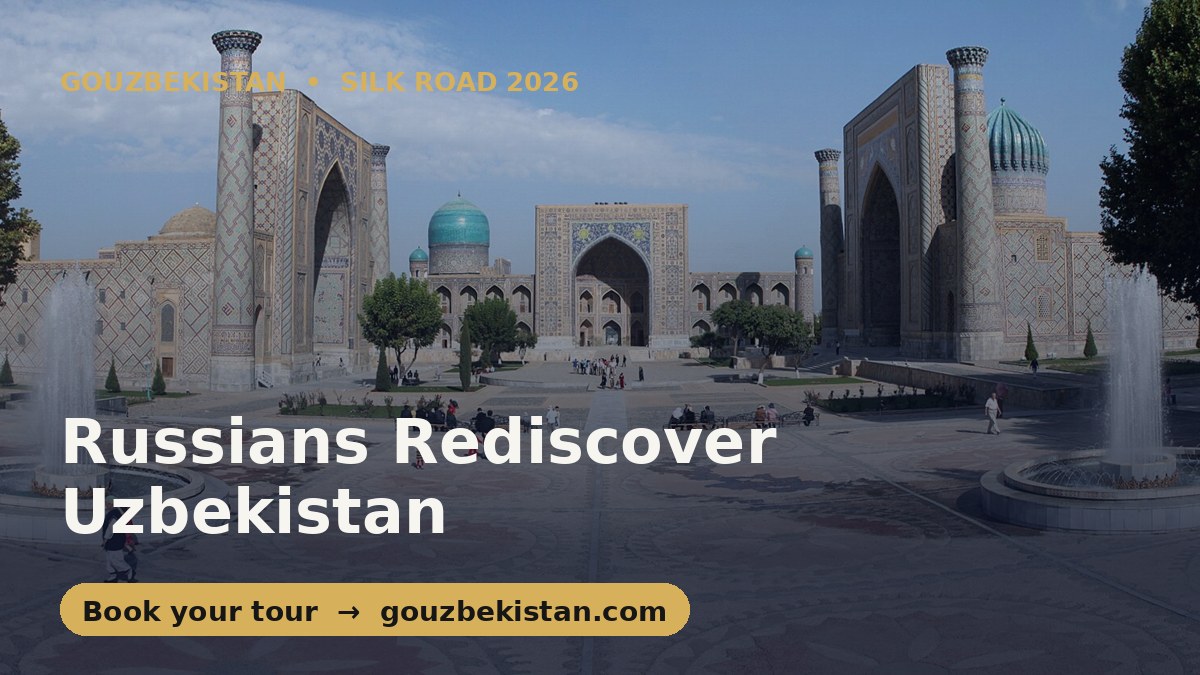
The Samarkand Xuanzang walked into was pre-Islamic, Sogdian, loud with trade. What rose on top of it seven centuries later is what makes people gasp today: the Registan's three madrasahs facing each other across a stone square, Bibi-Khanym's shattered blue arch, and Shah-i-Zinda — a narrow lane of tombs tiled floor to ceiling in every blue that has ever been fired, so quiet at eight in the morning that you can hear your own footsteps.
Go on to Bukhara, two hours away by high-speed train, and the scale changes: no monuments to crane at, just a whole living town of mud-brick lanes, a minaret that Genghis Khan reportedly refused to destroy, and a pool under mulberry trees where old men have argued over tea for four hundred years. Khiva, further west, is a walled desert city you can circle in an afternoon and never quite finish looking at.
Visa-free Uzbekistan: 30 days for Chinese passport holders
The practical wall that used to stand between Chinese travellers and this road is gone. Since 1 June 2025 a mutual visa-free agreement lets Chinese and Uzbek citizens travel between the two countries without a visa for up to 30 days per entry, within a 90-day limit over any 180-day period. Direct flights now link Xi'an — Xuanzang's own departure point — with Samarkand, and Urumqi with both Samarkand and Tashkent.
The response has been immediate. Uzbekistan welcomed more than 7.7 million foreign visitors in the first seven months of 2026, up over 22 percent year on year, and arrivals from China have multiplied several times over since the agreement took effect. Inside the country, Afrosiyob high-speed trains connect Tashkent, Samarkand and Bukhara in hours rather than days, so the route that cost Xuanzang months of walking now costs you an afternoon and a window seat.
How to travel the Xuanzang route in Uzbekistan
A good pilgrim-route itinerary runs Tashkent — the old Chach — then Samarkand for two full days, Bukhara for two more, and, for travellers who want the Buddhist chapter rather than the Islamic one, a flight south to Termez. Xuanzang's record describes the monasteries of Tokharistan, the region that today includes southern Uzbekistan, and the excavated stupas and monastery walls of Fayaz-Tepa and Kara-Tepa still stand above the Amu Darya. Almost no tour buses go there. That is precisely the point.
Autumn is the season to do it: September and October bring mild days, ripe melons and pomegranates in every bazaar, and light that makes the tilework glow rather than glare.
GoUzbekistan has been running ground operations in Uzbekistan since 2007, with offices in Tashkent and Bukhara, and holds tour-operator licence No. 662280 from the Committee for Tourism Development of the Republic of Uzbekistan. We build these routes ourselves — our own guides, our own drivers, our own relationships with the small hotels inside the old cities. Tell us how many days you have and what you want to feel, and we will build the road around it. Create your own custom tour, or explore our tours for ready-made Silk Road itineraries.
Xuanzang came back with 657 texts, twenty horses and a reputation that outlived his dynasty. You only need a week.
Plan your Uzbekistan trip — in your language
العربية — السياحة في أوزبكستان على طريق الحرير
سمرقند وبخارى وخيوة تنتظرك: قباب فيروزية، أسواق حرير، وضيافة دافئة على طريق الحرير. رحلات خاصة بسائق ومرشد يتحدث العربية، وفنادق مختارة، ومطاعم حلال في كل مدينة. صمّم رحلتك الخاصة إلى أوزبكستان أو تصفّح برامجنا السياحية.
Deutsch — Usbekistan Reise und Seidenstraße Rundreise
Samarkand, Buchara und Chiwa in einer Rundreise: türkisfarbene Kuppeln, Karawansereien und Schnellzüge zwischen den Oasenstädten. Wir planen Ihre Usbekistan Reise individuell — mit deutschsprachiger Reiseleitung und ausgesuchten Hotels. Jetzt Ihre Reise zusammenstellen oder unsere Rundreisen ansehen.
Español — Viajes a Uzbekistán por la Ruta de la Seda
Samarcanda, Bujará y Jiva: cúpulas turquesas, bazares de especias y noches en caravasares restaurados. Diseñamos tu viaje a Uzbekistán a medida, con guías en español y hoteles seleccionados. Crea tu viaje personalizado o descubre nuestros circuitos.
Français — Voyage en Ouzbékistan sur la Route de la Soie
Samarcande, Boukhara et Khiva vous attendent : coupoles turquoise, ateliers de soie et trains rapides entre les oasis. Nous construisons votre voyage en Ouzbékistan sur mesure, avec guides francophones et hôtels choisis. Composez votre voyage ou parcourez nos circuits.
中文 — 乌兹别克斯坦旅游·丝绸之路·撒马尔罕
撒马尔罕、布哈拉、希瓦——蓝色穹顶、香料市集与丝绸之路的千年故事。中国公民免签入境,我们提供中文向导、精选酒店与高铁衔接的定制行程。定制您的专属行程,或浏览我们的线路。
Русский — Туры в Узбекистан по Шёлковому пути
Самарканд, Бухара и Хива: бирюзовые купола, шумные базары и скоростные поезда между городами-оазисами. Составим индивидуальный тур в Узбекистан — русскоязычные гиды, проверенные отели, трансферы. Создать свой тур или посмотреть готовые туры.