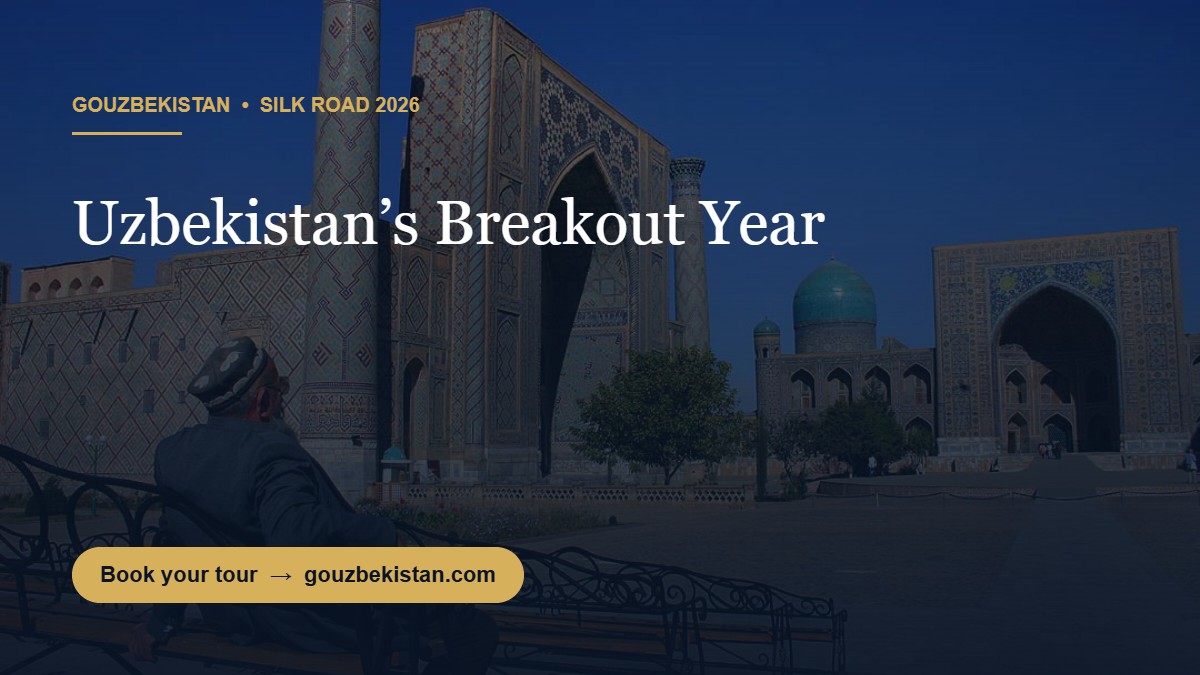
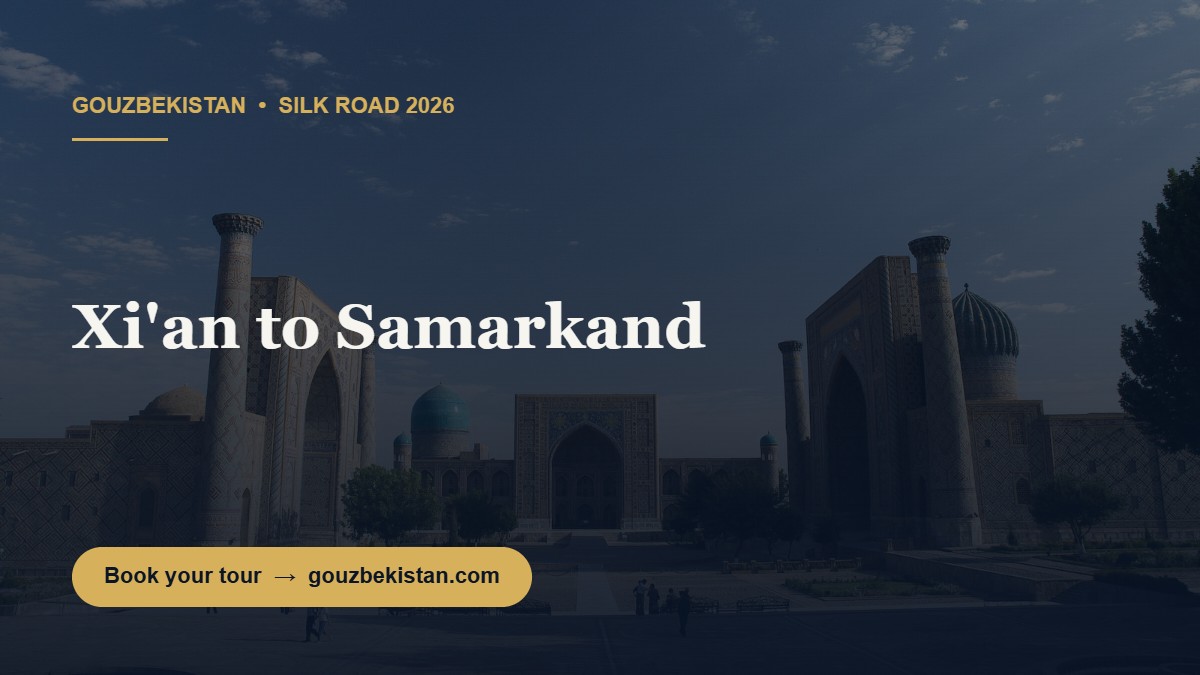
At six in the morning in a Nuratau village, the loudest thing you will hear is a donkey somewhere below the walnut trees. Smoke is already curling from a clay tandyr oven, your host's mother is pulling flat bread out of it with bare forearms, and the ridge above the house has turned the colour of apricot jam. Four hours' drive east, coaches are pulling up outside Samarkand's Registan. Here there is no queue, no ticket office, and no one trying to sell you anything.
This is the Uzbekistan that German, Austrian and Swiss travellers keep telling us they came for — and very nearly drove straight past. It sits in the gap between the great Silk Road cities, in the mountains and the desert that most itineraries treat as the boring bit in the middle. It is, in fact, the best part.
Wandern in Usbekistan: the Nuratau range is Central Asia's quietest walking country
The Nuratau mountains run east from the small town of Nurata, a spine of dry ridges and spring-fed valleys separating the Kyzylkum Desert from the foothills that eventually climb toward the Tian Shan. The villages tucked into those valleys — Hayat, Sentyab, Uhum, Asraf — are green ribbons in an otherwise beige landscape, kept alive by mountain springs and shaded by walnut and mulberry trees planted generations ago.
You walk here for the same reason you walk in the Alps: because the landscape only makes sense at three kilometres an hour. Trails climb from village level through terraced apricot orchards onto open ridgelines where the only traffic is a shepherd and four hundred sheep. From the top you can see the desert on one side and the mountains folding away on the other. Days are moderate rather than brutal — most walks run three to six hours, with real paths and real gradients, but no technical scrambling and no altitude problem.
Homestay statt Hotel: where your money actually goes
There are no resorts in the Nuratau. You sleep in family homes, on a mattress in a guest room, and you eat what the household grows: bread from the tandyr, apricots dried on the roof, yoghurt, tomatoes still warm from the garden, and a plov cooked over wood in the courtyard. A community-based tourism network coordinates the bookings so no single family is overloaded, which is why the villages still feel like villages and not like a stage set.
For travellers from the DACH region who ask us — often in the first email — where the money goes, this is the honest answer: in a Nuratau homestay it goes to the household you are sitting with. That is unusually easy to verify when your host's daughter is pouring your tea.
Aydarkul: a lake in the Kyzylkum that was never supposed to be there
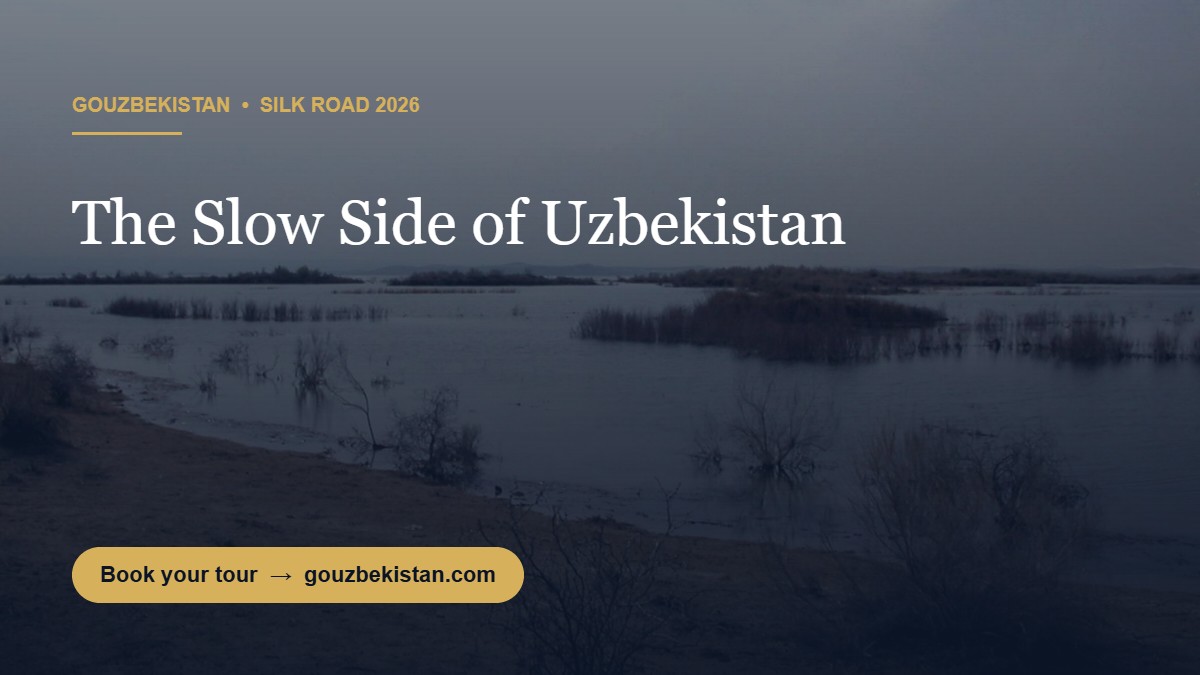
Drop south out of the mountains and the green stops abruptly. Then, improbably, there is water — a great pale sheet of it stretching to the horizon. Lake Aydarkul was not planned. It formed after 1969, when floodwater spilled out of the Chardara reservoir into the Arnasay depression and simply stayed, filling a hollow in the desert. Half a century on, it is a genuine lake with fishermen, gulls, and reeds.
You sleep on its edge in a yurt: round, felt-walled, carpeted, warm once the door is shut. The evening runs on its own schedule — grilled fish, a fire, someone with a dutar, and then a sky so thoroughly unpolluted by light that the Milky Way is not a metaphor but a visible band. Camels graze the dunes behind camp. It is theatrical, and it is also just what the shore looks like.
Why autumn is the right window for a Usbekistan Rundreise
September and October are the two best months of the Uzbek year. The furnace heat of July has broken, days settle into the low twenties to high twenties Celsius, nights turn cool enough for a jacket in the mountains, and the harvest arrives all at once: melons, grapes, pomegranates, figs, and the year's apricots hanging in strings from village eaves. The light in autumn is long and low, which is exactly what you want against turquoise tilework and dun-coloured ridges.
Practically, it is also a straightforward country to reach and to move around. Citizens of some 90 countries — including Germany, Austria, Switzerland, the wider EU, the UK, the US and the Gulf states — enter Uzbekistan visa-free, with 30 days the standard allowance for most European passports. Afrosiyob high-speed trains link Tashkent, Samarkand and Bukhara in hours rather than days, so the cities are quick and the slow part of the trip is the part that deserves to be slow.
How to put the villages and the Silk Road cities in one trip
The pairing works because the contrast works. Two or three nights in the Nuratau and by Aydarkul, dropped into the middle of a classic Tashkent–Samarkand–Bukhara–Khiva route, changes the whole rhythm of the journey: you arrive in Bukhara having actually rested, rather than having seen your eighth madrasah in four days. On the way you can stop at Nurata itself, where a sacred spring runs beside the ruins of a fortress traditionally attributed to Alexander the Great, and at the Sarmishsay gorge near Navoi, where thousands of petroglyphs record several thousand years of people passing through this same landscape on foot.
GoUzbekistan has been operating in this country since 2007, and we are based in Bukhara — not in a foreign office reading about it. We hold tour-operator licence No. 662280 from the Committee for Tourism Development, and we build these routes as private, custom trips rather than fixed group departures, because the right number of nights in a village is different for every traveller.
Ready to see the quiet half of Uzbekistan? Create your own custom tour and tell us how much walking you want, or explore our tours for routes that already combine the Silk Road cities with the mountains and the lake.
Plan your Uzbekistan trip — in your language
Deutsch — Usbekistan Reise abseits der Touristenpfade
Wandern im Nuratau-Gebirge, Übernachtung bei einer usbekischen Gastfamilie und eine Nacht in der Jurte am Aydarkul-See: Das ist die Usbekistan Rundreise, die zwischen Samarkand und Buchara fast immer übersehen wird. Der Herbst ist die beste Reisezeit auf der Seidenstraße — mild, farbig und voller Ernte. Stellen Sie hier Ihre individuelle Usbekistan Reise zusammen.
العربية — رحلات إلى أوزبكستان بعيداً عن الزحام
بين سمرقند وبخارى تنتظرك جبال نوراتاو الهادئة وبحيرة أيدركول وسط الصحراء، حيث تقيم في بيوت القرويين وتنام ليلة في خيمة تقليدية تحت سماء مليئة بالنجوم. الخريف هو أفضل موسم لزيارة طريق الحرير في أوزبكستان. صمّم رحلتك الخاصة إلى أوزبكستان الآن.
Español — Viajes a Uzbekistán fuera de las rutas turísticas
Entre Samarcanda y Bujará se esconden las montañas de Nuratau y el lago Aydarkul, en pleno desierto: casas de familia, senderismo tranquilo y una noche en una yurta bajo la Vía Láctea. El otoño es la mejor época para recorrer la Ruta de la Seda en Uzbekistán. Diseña tu viaje a medida a Uzbekistán.
Français — Voyage en Ouzbékistan loin des foules
Entre Samarcande et Boukhara, les montagnes de Nuratau et le lac Aydarkoul offrent des randonnées paisibles, des nuits chez l'habitant et une soirée sous la yourte au milieu du désert. L'automne est la meilleure saison pour parcourir la Route de la Soie en Ouzbékistan. Composez votre voyage sur mesure en Ouzbékistan.
中文 — 乌兹别克斯坦旅游:撒马尔罕与布哈拉之间的宁静
在撒马尔罕与布哈拉之间,努拉套山脉和沙漠中的艾达尔湖等着您:在山间村落徒步、住进当地民宿、在毡房中度过一个满天星斗的夜晚。秋季是丝绸之路旅行的最佳季节。立即定制您的乌兹别克斯坦专属行程。
Русский — Туры в Узбекистан вдали от туристических маршрутов
Между Самаркандом и Бухарой вас ждут Нуратинские горы и озеро Айдаркуль посреди пустыни: пешие маршруты по горным кишлакам, ночёвка в гостевом доме у местной семьи и вечер в юрте под Млечным Путём. Осень — лучшее время для путешествия по Шёлковому пути. Составьте свой индивидуальный тур в Узбекистан.