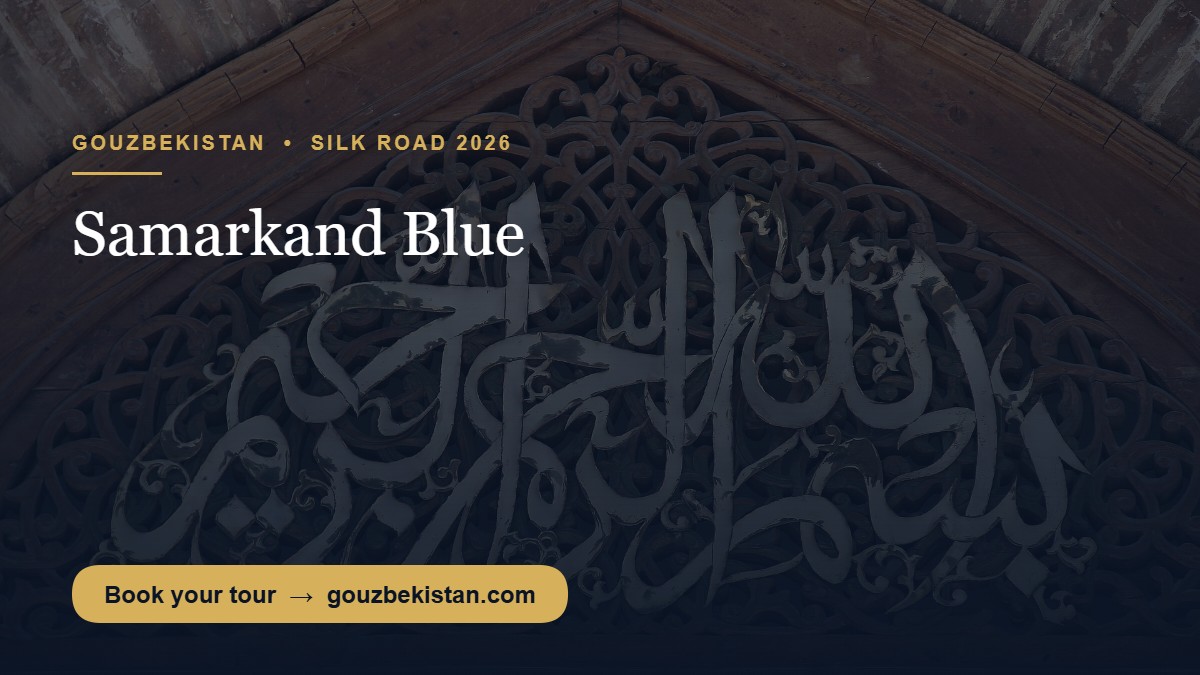
Step through the low gate of Shah-i-Zinda a little after sunrise, before the first coach arrives, and the colour reaches you before the architecture does. A narrow lane climbs between mausoleums, and every wall of it is blue: turquoise, cobalt, a green so deep it looks wet, with white script running across the arches like foam on a wave. Samarkand has been given many names over the centuries. Standing in that lane at seven in the morning, you understand why so many travellers simply called it blue.
For Spanish travellers, this blue does something unexpected. It feels like a memory. The same geometry that covers the walls of Seville and Granada in glazed tile travelled the other way along the Silk Road, and here it grew: taller, deeper, more confident, until whole domes were dressed in it. You do not need to know a word of Uzbek to read it. You have seen this alphabet of colour before.
Shah-i-Zinda: the most beautiful street in Samarkand
Shah-i-Zinda is not one monument but a conversation between twenty of them, built and rebuilt between the 11th and 19th centuries around the shrine of Kusam ibn Abbas. Because each generation of patrons added a facade beside the last, the avenue is a museum of ceramic technique in chronological order: carved terracotta, then majolica, then the glittering mosaic faience of the Timurid century. Come early. The lane faces east, and for about forty minutes after sunrise the tilework holds light the way water does.
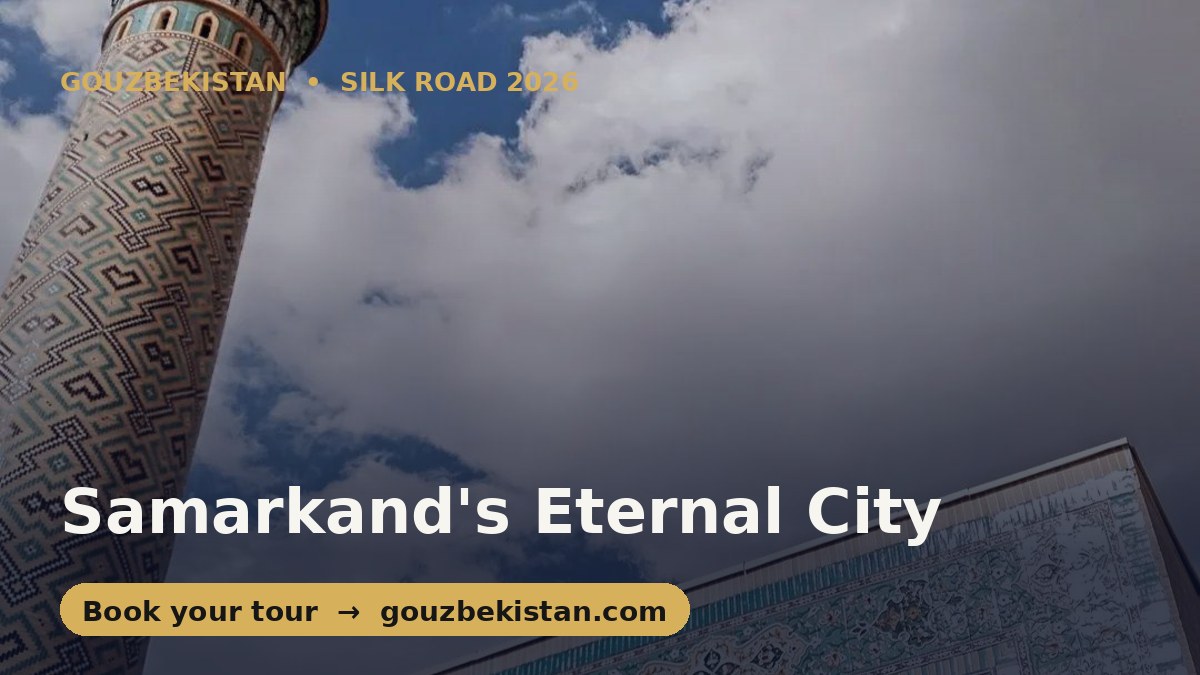
Five minutes away, the Gur-e-Amir keeps Timur under a ribbed turquoise dome that has become the silhouette of the whole country. At the Registan, three madrasahs face one another across an open square: Ulugh Beg's, begun in 1417 by a ruler who was an astronomer first and a prince second; Sher-Dor, with its famous lions that should not exist in Islamic art and do anyway; and Tilya-Kori, whose gold-leafed ceiling reads as a dome from below and is, in fact, almost flat. Samarkand has been on the UNESCO World Heritage list as Crossroads of Cultures since 2001, and the square is the reason most people book the flight.
Rishtan and the ishkor glaze: a September secret in the Fergana Valley
The blue has a recipe, and it is still mixed by hand. Six hours east of Samarkand, the small Fergana Valley town of Rishtan has been firing pottery for more than a thousand years. Its masters glaze with ishkor: ash from desert plants that grow around the town, blended with crushed quartz. The plants are gathered in late September, which means an autumn visit lands you in the workshops exactly when the year's colour is being made.
The result is unmistakable once you have held it: turquoise and dark blue drawn over a milky white ground, the surface soft rather than glassy. On our custom itineraries we build in time at a working kuzagar studio, where you throw a bowl badly, watch a master throw one perfectly in ninety seconds, and leave understanding why this glaze was traded from China to Arabia.
From azulejos to majolica: why Spanish travellers feel at home on the Silk Road
Uzbekistan is having an extraordinary year. In the first seven months of 2026 the country welcomed 7.75 million foreign visitors, 22.6 percent more than a year earlier. Spain has noticed. Spanish tourism groups have opened talks about hotel investment in Uzbekistan, and the operator behind Iberojet has signalled its readiness to increase direct charter flights from Spain to Tashkent and Urgench, the gateway to Khiva. Add September and October daytime temperatures of roughly 22 to 28 degrees, and this is the moment to go before the corridor fills.
How to travel it properly
Samarkand alone will not do it. The colour argument only closes when you have seen Bukhara's plainer, older brick beside Samarkand's ceramic extravagance, and then Khiva inside its walls at dusk. A well-built route gives you three days at the western end, high-speed rail between the cities, and a driver who knows which gate at Shah-i-Zinda opens first. That is what we do: GoUzbekistan is the brand of Lochin Express Plyus LLC, a licensed tour operator working in Uzbek tourism since 2007, based at Islam Karimov Street 21 in Bukhara and holding tour-operator licence No. 662280 from the Committee for Tourism Development.
Tell us your dates and how slowly you like to travel, and we will build the route around you. Create your own custom tour or explore our tours.
Plan your Uzbekistan trip - in your language
Español
El azul de Samarcanda le resultará familiar: la misma geometría de los azulejos andaluces, pero cubriendo cúpulas enteras. Organizamos viajes a Uzbekistán a medida por la Ruta de la Seda, con Samarcanda, Bujará y Jiva, guías en español y talleres de cerámica en Rishtán. Diseñe su viaje a medida.
Français
Le bleu de Samarcande se découvre au lever du jour, quand la lumière entre dans la ruelle de Chah-i-Zinda. Nous concevons votre voyage en Ouzbékistan sur mesure le long de la Route de la Soie : Samarcande, Boukhara, Khiva, trains rapides et artisans du carreau. Découvrez nos circuits.
Deutsch
Das Blau von Samarkand ist kein Zufall, sondern ein Rezept, das in Rischtan bis heute von Hand gemischt wird. Wir planen Ihre Usbekistan Reise als maßgeschneiderte Seidenstraße Rundreise mit Samarkand, Buchara und Chiwa. Reise individuell planen.
Русский
Синий цвет Самарканда лучше всего виден на рассвете, когда солнце входит в улицу Шахи-Зинда. Мы организуем индивидуальные туры в Узбекистан по Шёлковому пути: Самарканд, Бухара, Хива, скоростные поезда и мастерские керамистов Риштана. Составить свой тур.
العربية
أزرق سمرقند ليس مصادفة، بل وصفة ما زال حرفيو ريشتان يمزجونها بأيديهم. ننظم رحلات السياحة في أوزبكستان على طريق الحرير: سمرقند وبخارى وخيوة، مع مرشدين ناطقين بالعربية ومطاعم حلال. صمم رحلتك الخاصة.
中文
撒马尔罕的蓝色最好在清晨观赏,此时阳光刚照进沙赫静达陵墓群的小巷。我们为您定制乌兹别克斯坦旅游线路,沿丝绸之路游览撒马尔罕、布哈拉与希瓦,并安排里什坦陶艺工坊体验。查看我们的线路.