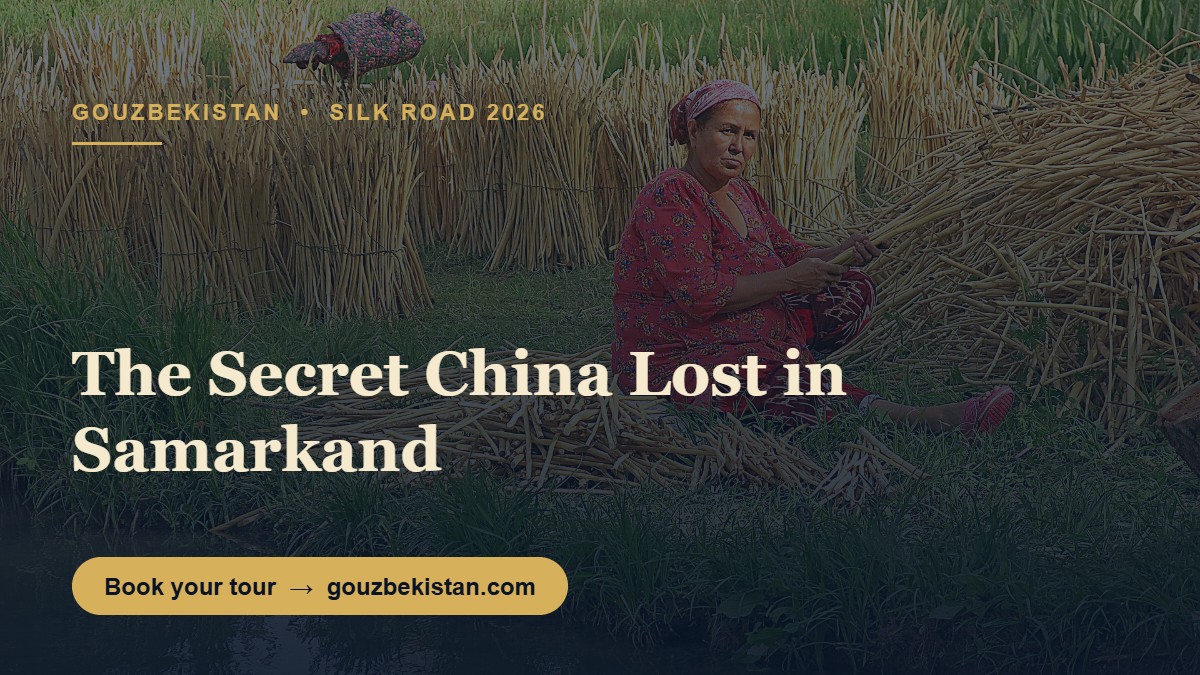
The water wheel turns first. Before you see anything, you hear it — a slow wooden groan, then the heavy, patient thud of hammers falling on wet mulberry bark, the same sound that echoed through this stretch of the Zarafshan river more than twelve hundred years ago. You are eight kilometres from the Registan, in a village called Konigil, and you are standing inside one of the most consequential secrets in human history.
In 751 AD, at the Battle of Talas, Tang dynasty armies met the Abbasid Caliphate on the far edge of the known world. Among the prisoners carried back toward Samarkand were craftsmen — and with them travelled a technique China had guarded for centuries: how to turn plant fibre into paper. Samarkand learned. Samarkand improved. Within a generation the city was producing a mulberry-bark sheet so smooth and so strong that it outsold Chinese paper across the Islamic world, replaced papyrus and parchment, and carried knowledge onward to Baghdad, Cairo, Córdoba and finally Europe. Every book you have ever held began its journey on this riverbank.
Samarkand paper: the Silk Road story Chinese travellers come to finish
For most visitors from China, Uzbekistan is a mirror held up at a strange angle. You recognise the ancestry — the silk, the ceramics, the caravan routes that started in Xi'an — but here it has been rewritten in turquoise tile and Persian poetry. Nowhere is that feeling sharper than at Konigil. This is not a story of something taken from China. It is a story of something China gave the world, preserved in a place China's own workshops have long since industrialised away.
At the Meros mill, revived by the Mukhtarov brothers using techniques reconstructed from medieval sources, the process is unchanged and entirely unhurried. Mulberry branches are stripped and soaked. The inner bark is boiled, then fed under water-driven wooden hammers until it collapses into pulp. A screen is dipped, lifted, drained. The wet sheet is pressed, dried, and then — the part everyone remembers — burnished with a polished agate or horn stone until it takes on a faint, warm sheen. Silk paper, they call it. Run your thumb across a sheet and you will understand why the name stuck.
Why Samarkand belongs on every China–Central Asia itinerary
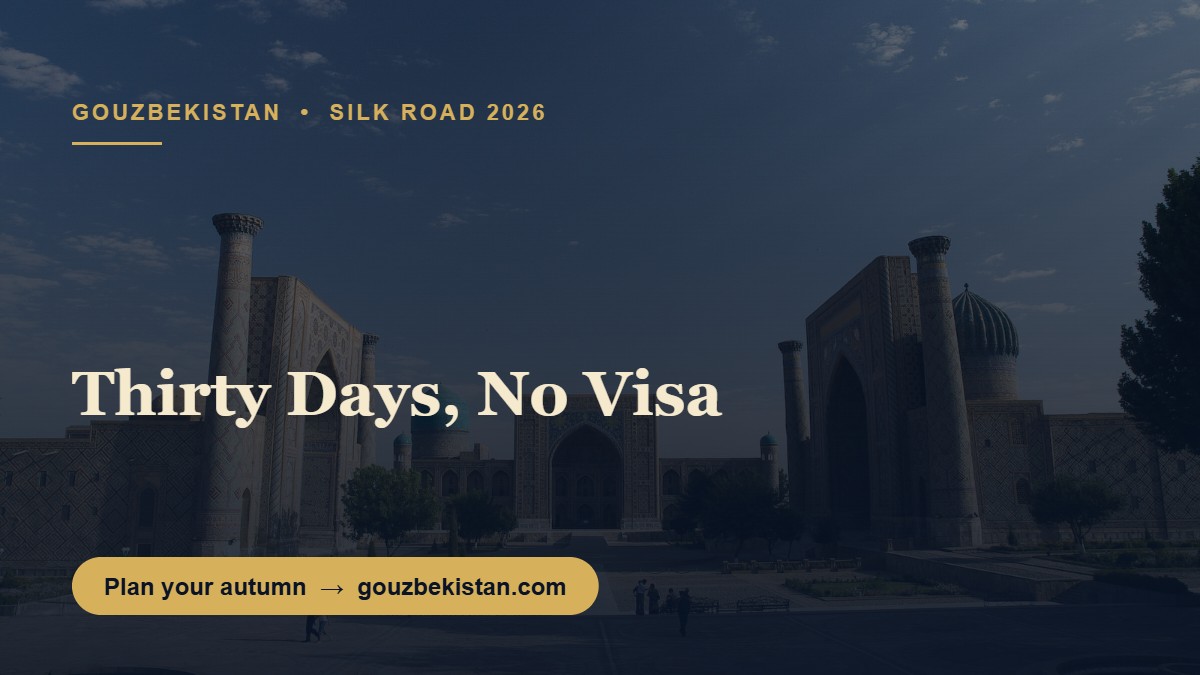
Getting here has never been easier. Since the visa-free regime between Uzbekistan and China took effect, travellers from China can enter for up to 30 days without a visa, and arrivals have risen sharply — 178,121 Chinese citizens visited in the first five months of 2026 alone. Direct air links now connect Chinese cities to Tashkent and Samarkand, and once you land, the Afrosiyob high-speed train covers Tashkent to Samarkand in a little over two hours. A country that once took caravans a season to cross now folds into a comfortable week.
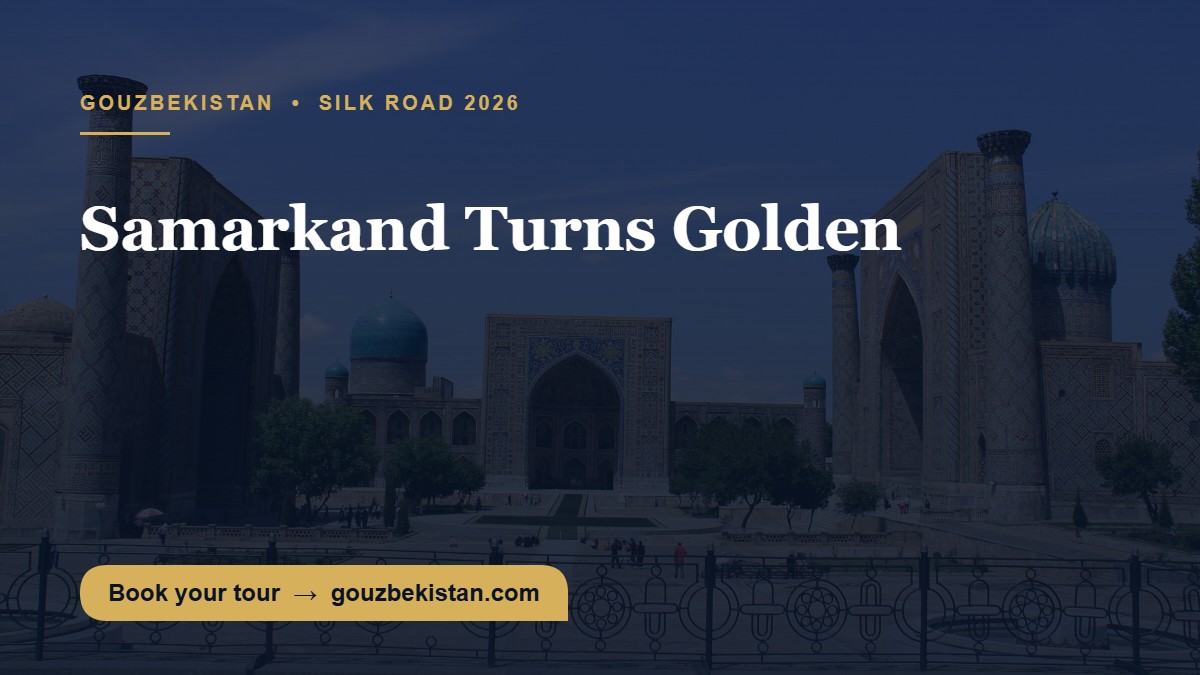
Autumn is the moment to come. Between September and late October the heat breaks, the light turns amber across the Registan's tilework, and the bazaars fill with melons, grapes and pomegranates. Days sit comfortably in the low twenties. Photographs taken in this season do not need editing.
What a paper-mill morning actually feels like
We build the visit slowly, because it deserves it. You arrive early, before the tour coaches, when the mist is still coming off the water channel. A master will hand you a wet sheet and let you press it yourself. There is tea under the mulberry trees, and a workshop where the paper becomes notebooks, calligraphy sheets, tiny bound books and papier-mâché masks. Most of our guests leave carrying a sheet they made with their own hands — the single best souvenir in Uzbekistan, and the only one that is genuinely one of a kind.
From Konigil it is twenty minutes back to Samarkand, where Ulugh Beg's observatory, Shah-i-Zinda's corridor of blue tombs and the Registan at dusk complete a day that moves from craft to cosmology without ever feeling rushed. Add Bukhara's quiet lanes and Khiva's walled old town and you have the Silk Road as it should be experienced: slowly, and in order.
Travel with a licensed Uzbek operator
GoUzbekistan is the travel brand of Lochin Express Plyus LLC, an Uzbek company operating since 2007 and holding tour-operator licence No. 662280, issued 13 March 2025 by the Committee for Tourism Development of the Republic of Uzbekistan. We are based in Bukhara, on Islam Karimov Street, and we run our own ground operations — which is why we can open a paper mill early, seat you under the right tree, and find the guide who can explain a Tang-dynasty technique in the language you think in.
Come and touch the paper. Create your own custom tour or explore our tours and we will build the rest of the Silk Road around it.
Plan your Uzbekistan trip — in your language
中文 — 撒马尔罕的纸,源自中国的秘密
公元751年,造纸术从中国传到撒马尔罕,如今在科尼吉尔村,桑树皮仍由水力木锤捶打成纸。中国公民可免签停留30天,高铁两小时直达撒马尔罕。秋季气候宜人,正是丝绸之路旅游的最佳季节。定制您的乌兹别克斯坦旅游行程,与持牌当地旅行社同行。
العربية — سمرقند وسرّ الورق على طريق الحرير
في قرية قرب سمرقند، لا يزال الورق يُصنع يدويًا من لحاء التوت كما كان قبل اثني عشر قرنًا. السياحة في أوزبكستان في الخريف تعني طقسًا معتدلاً وأسواقًا عامرة بالرمان والعنب. رحلات على طريق الحرير بين سمرقند وبخارى وخيوة مع مشغّل سياحي مرخّص. صمّم رحلتك الخاصة إلى أوزبكستان.
Deutsch — Samarkand und das Geheimnis des Seidenpapiers
In einem Dorf bei Samarkand wird Papier noch immer von Hand aus Maulbeerrinde geschöpft — eine Kunst, die im Jahr 751 aus China hierherkam. Eine Usbekistan Reise im Herbst verbindet mildes Wetter, goldenes Licht und volle Basare. Erleben Sie die Seidenstraße Rundreise von Samarkand über Buchara bis Chiwa. Entdecken Sie unsere Reisen.
Español — Samarcanda y el secreto del papel de seda
En una aldea junto a Samarcanda, el papel todavía se fabrica a mano con corteza de morera, un arte llegado de China en el año 751. El otoño es la mejor época para los viajes a Uzbekistán: clima suave, luz dorada y bazares repletos de granadas. Recorra la Ruta de la Seda entre Samarcanda, Bujará y Jiva. Diseñe su viaje a medida.
Français — Samarcande et le secret du papier de soie
Dans un village près de Samarcande, le papier est toujours fabriqué à la main à partir d'écorce de mûrier, un savoir-faire venu de Chine en 751. L'automne est la saison idéale pour un voyage en Ouzbékistan : douceur du climat, lumière dorée, bazars débordants. Parcourez la Route de la Soie de Samarcande à Boukhara et Khiva. Découvrez nos circuits.
Русский — Самарканд и тайна шёлковой бумаги
В посёлке под Самаркандом бумагу до сих пор делают вручную из коры тутовника — ремесло, пришедшее из Китая в 751 году. Осень — лучшее время для туров в Узбекистан: мягкая погода, золотой свет и базары, полные гранатов и винограда. Шёлковый путь от Самарканда до Бухары и Хивы с лицензированным туроператором. Составьте свой индивидуальный тур.