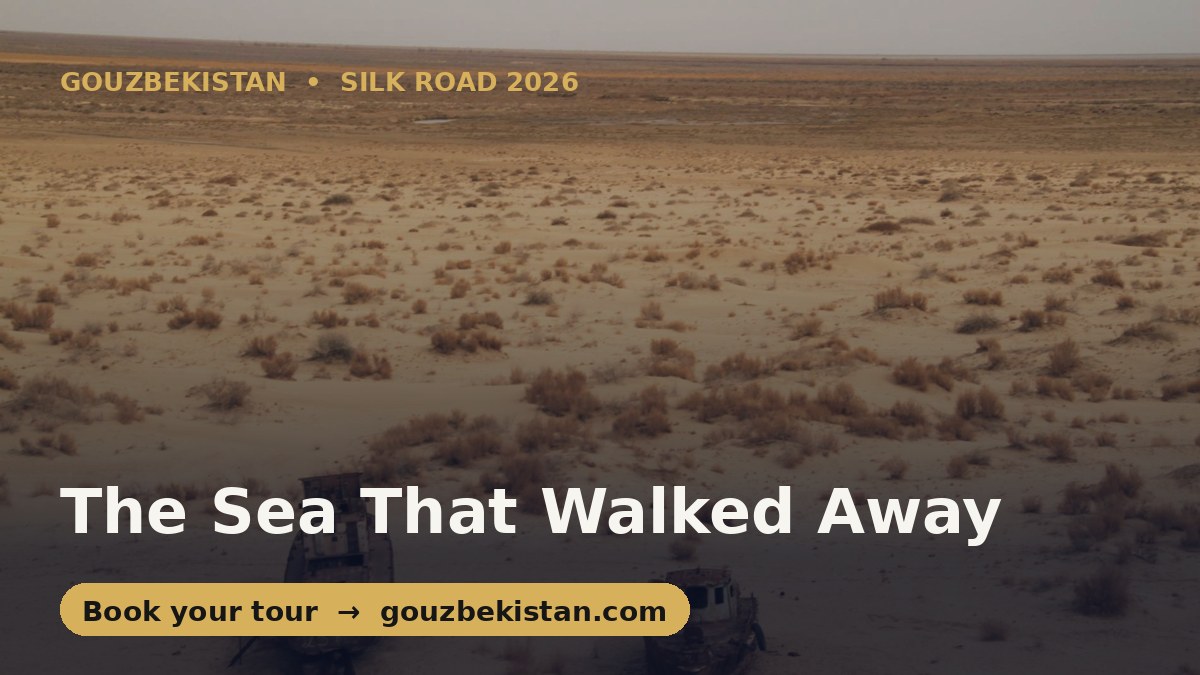
You smell it before you see it: dry salt, on a wind that has nothing left to cross. Then the road ends at a low cliff, and below you, on cracked pale ground where the water used to be, a line of fishing trawlers sits rusting in the sand. No sea. Just boats, a horizon, and a silence so complete that your own footsteps sound like an intrusion.
This is Moynaq, in the far north-west of Uzbekistan — once a busy fishing port on the Aral Sea, today the most quietly devastating place on the Silk Road.
What happened to the Aral Sea
The Aral was the fourth-largest lake on earth. From the 1960s, the two rivers that fed it — the Amu Darya and the Syr Darya — were diverted to irrigate cotton across the Soviet republics. The sea began to retreat, and it never stopped. It has lost more than ninety per cent of its surface area. The shoreline that once lapped at Moynaq's cannery is now well over a hundred kilometres away, and in its place lies the Aralkum: the youngest desert on the planet, a seabed you can walk across.
The ships were left where they grounded. Around a dozen trawlers and cargo barges now stand in a row beneath the old bluff, exactly where the water ended; since 2019 they have been stabilised and cared for as a state open-air museum, with a concrete anchor monument above them. In the town's former House of Culture, the Aral Sea Museum keeps what the water took with it — a hundred photographs, fishing nets, ship models, the bright optimistic posters of a fishing industry that employed tens of thousands of people.
Why travellers are going further into Uzbekistan in 2026
Something is shifting in how people travel this country. International arrivals rose more than twenty per cent in the first eight months of 2026, and — more tellingly — visitors are staying longer and pushing further from the classic Samarkand-Bukhara-Khiva triangle. Karakalpakstan, the vast autonomous republic that holds Moynaq, is where a lot of that curiosity is going.
It is not grief tourism. The people who live here are not an exhibit; they are a community that lost an ocean and stayed. Local guides frame the trip as both ecological and cultural, and they are the ones who should tell it. You come away understanding something about water that no documentary can teach you, and you leave money in a town that badly needs visitors to keep coming.
How to visit Moynaq: the practical route
Moynaq sits roughly three hours north of Nukus by road, across flat steppe that slowly loses its colour. Most travellers make it a long day trip from Nukus, but the better version is an overnight: yurt camp on the old seabed, dinner under a sky with no light pollution for two hundred kilometres, sunrise over the ships.
Pair it with two things. First, Nukus itself — the Savitsky Museum holds one of the world's great collections of banned Soviet avant-garde art, saved by one man in a desert nobody was watching. Second, Khiva: the walled city is a four-hour drive away, and direct international flights now land at Urgench, which makes this whole north-western loop far easier to reach than it was even two years ago. Four days gets you Khiva, Nukus, Moynaq and back.
Autumn is the right season. The summer heat over the Ustyurt plateau is punishing; from late September the days are clear and mild, and the light on the hulls at dawn and dusk is what photographers come for. Bring wind protection, closed shoes for the salt crust, and more water than you think.
Uzbekistan is visa-free for most of the world
More than ninety nationalities — including the EU, the UK, the Gulf states and, since January 2026, the United States — enter Uzbekistan without a visa. There is no permit needed for Karakalpakstan and no closed-zone paperwork. What the region does need is a driver and a guide who know the roads, the fuel stops and the families who host in Moynaq.
GoUzbekistan is a licensed Uzbek tour operator (licence No. 662280, Committee for Tourism Development), based in Bukhara and operating since 2007. We build the Aral route privately, at your pace, with local Karakalpak guides.
Go and see it while there is still someone to show you. Create your own custom tour with the Aral Sea built in, or explore our tours across the Silk Road.
Plan your Uzbekistan trip — in your language
العربية
في أقصى شمال غرب أوزبكستان تقف سفن الصيد على قاع بحر آرال الجاف — مشهد لا يُنسى. اجمع موينق ونوكوس مع مدن طريق الحرير: سمرقند وبخارى وخيوة. السياحة في أوزبكستان بدون تأشيرة لأكثر من تسعين دولة. صمّم رحلتك الخاصة.
Deutsch
Eine Usbekistan Reise abseits der Routen: In Mo'ynoq rosten Fischerboote auf dem trockenen Grund des Aralsees. Kombinieren Sie den Aralsee und Nukus mit einer klassischen Seidenstraße Rundreise über Chiwa, Buchara und Samarkand. Entdecken Sie unsere Reisen.
Español
Viajes a Uzbekistán más allá de lo previsible: en Moynaq los barcos pesqueros se oxidan sobre el lecho seco del mar de Aral. Sume esa etapa a la Ruta de la Seda: Jiva, Bujará y Samarcanda, en un circuito privado. Diseñe su viaje a medida.
Français
Un voyage en Ouzbékistan hors des sentiers battus : à Moynaq, les chalutiers rouillent sur le fond asséché de la mer d'Aral. Ajoutez cette étape à la Route de la Soie — Khiva, Boukhara et Samarcande. Créez votre voyage sur mesure.
中文
乌兹别克斯坦旅游的另一面:在木伊纳克,渔船锈蚀在干涸的咸海湖床上。将咸海与努库斯,同丝绸之路名城希瓦、布哈拉和撒马尔罕串成一条私人定制线路。查看我们的线路。
Русский
Туры в Узбекистан за пределами привычного маршрута: в Муйнаке рыболовецкие суда ржавеют на высохшем дне Аральского моря. Добавьте Арал и Нукус к классическому Шёлковому пути — Хива, Бухара, Самарканд. Составьте индивидуальный тур.