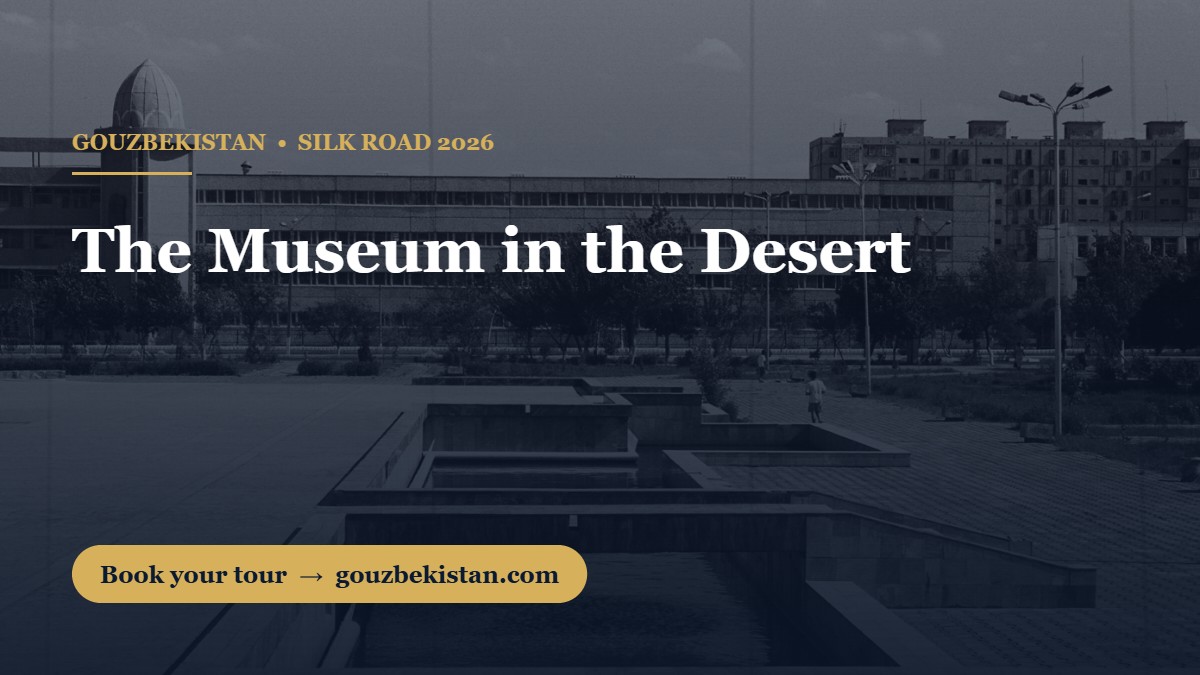
Drive nine hours west of Bukhara and the Silk Road runs out. The domes stop, the trees thin, and the road opens onto flat pale desert where the wind moves the sand across the tarmac in slow ribbons. At the end of it is Nukus - a low, sun-bleached town most travellers have never heard of. Inside an unremarkable building there hang paintings that people were once imprisoned for making.
This is the Savitsky Museum, and it is the most improbable art collection on earth.
The man who hid a generation of artists
Igor Savitsky arrived in Karakalpakstan as an archaeological illustrator and stayed for the rest of his life. Through the 1960s and 1970s he travelled to Moscow and Tashkent and bought - often on credit, often with money he did not have - the work of avant-garde painters whose canvases had been declared formalist, anti-Soviet, dangerous. Some of those artists had died in camps. Some had spent decades painting for no audience at all. Their widows kept the canvases rolled under beds.
Savitsky carried the work back to the desert precisely because it was the desert. Nukus was too remote, too dusty and too politically insignificant for anyone in Moscow to bother inspecting. He built one of the world largest collections of Soviet avant-garde and Turkestan modernist art in the one place the censors would never look. He died in 1984, and for years almost nobody outside Uzbekistan knew what was there.
What you actually see
Room after room of colour you do not expect: Central Asian light broken into planes, cotton pickers rendered like Byzantine saints, a red bull that stops people mid-sentence. Alongside it sits a superb ethnographic collection of Karakalpak jewellery, yurt textiles and carved wood - the material culture of a people whose sea disappeared within one lifetime.
Visitors consistently describe the same reaction: they came for an hour and stayed for three, and left quieter than they arrived. It is not a grand museum. That is exactly why it lands.
Nukus and the Aral: the honest edge of Uzbekistan
Three hours further north lies Moynaq, once a fishing port, now a bluff overlooking dry seabed where rusting trawlers sit in the sand. Standing between the ships and the horizon is one of the few travel experiences that genuinely changes how you think - about water, about ambition, about how quickly a landscape can be undone. Paired with Savitsky in the morning, it makes for a day that no beach holiday can match.
The region also rewards anyone chasing a night sky. Out past Moynaq the darkness is close to total, and yurt camps on the old shoreline serve fish, bread and tea under a Milky Way that looks artificially bright.
How to fit Nukus into an Uzbekistan itinerary
Nukus has an airport with regular domestic flights from Tashkent, which makes the classic route simple: fly in, spend a day with Savitsky and Moynaq, then drive three hours south-east to Khiva and rejoin the Silk Road. From Khiva the road runs to Bukhara and Samarkand, and the high-speed Afrosiyob train carries you back to Tashkent in comfort.
Autumn is the right season. September and October bring 22 to 28 degrees, dry air and the harvest - and the desert light in October is the best of the year for photographers. Uzbekistan is visa-free for citizens of more than 90 countries and offers a fast online e-visa for most others, so the paperwork is rarely the obstacle. Between January and July 2026 the country welcomed 7,749,308 foreign visitors, up 22.6 percent year on year - but Nukus still feels like a secret.
Travel it with people who live here
GoUzbekistan is a licensed Uzbek tour operator (licence No. 662280, Committee for Tourism Development), operating since 2007 and based in Bukhara. We run Karakalpakstan as a private trip with our own guides, because the distances are long and the interesting parts are not on the signposts.
Ready when you are: create your own custom tour, or explore our tours across Samarkand, Bukhara, Khiva and the Aral.
Plan your Uzbekistan trip - in your language
العربية
السياحة في أوزبكستان لا تقتصر على سمرقند وطريق الحرير: في مدينة نوكوس الصحراوية متحف يضم آلاف اللوحات النادرة التي أُنقذت من الإتلاف. نصمم لك رحلة خاصة تجمع بين المدن التاريخية والصحراء. صمّم رحلتك الخاصة
Deutsch
Ihre Usbekistan Reise muss nicht in Samarkand enden. In Nukus wartet eine der groessten Sammlungen sowjetischer Avantgarde - versteckt in der Wueste. Wir planen Ihre private Seidenstrasse Rundreise inklusive Chiwa und Aralsee. Gestalten Sie Ihre eigene Reise
Español
Los viajes a Uzbekistan pueden ir mas alla de Samarcanda: en Nukus, en pleno desierto, se esconde una de las grandes colecciones de vanguardia del mundo. Disenamos su ruta privada por la Ruta de la Seda, Jiva y el mar de Aral. Crea tu viaje a medida
Français
Un voyage Ouzbekistan ne s arrete pas a Samarcande. A Noukous, en plein desert, se cache l une des plus grandes collections d avant-garde au monde. Nous creons votre circuit prive sur la Route de la Soie, avec Khiva et la mer d Aral. Composez votre voyage sur mesure
中文
乌兹别克斯坦旅游不只有撒马尔罕与丝绸之路。在沙漠深处的努库斯,藏着世界上最重要的先锋派艺术收藏之一,还有咸海的旧渔船。我们为您定制包含希瓦与咸海的私人行程。定制您的专属行程
Русский
Туры в Узбекистан - это не только Самарканд и Шёлковый путь. В пустынном Нукусе хранится одна из крупнейших коллекций советского авангарда, а рядом - корабли Муйнака на дне ушедшего моря. Составим ваш индивидуальный маршрут. Составить свой тур