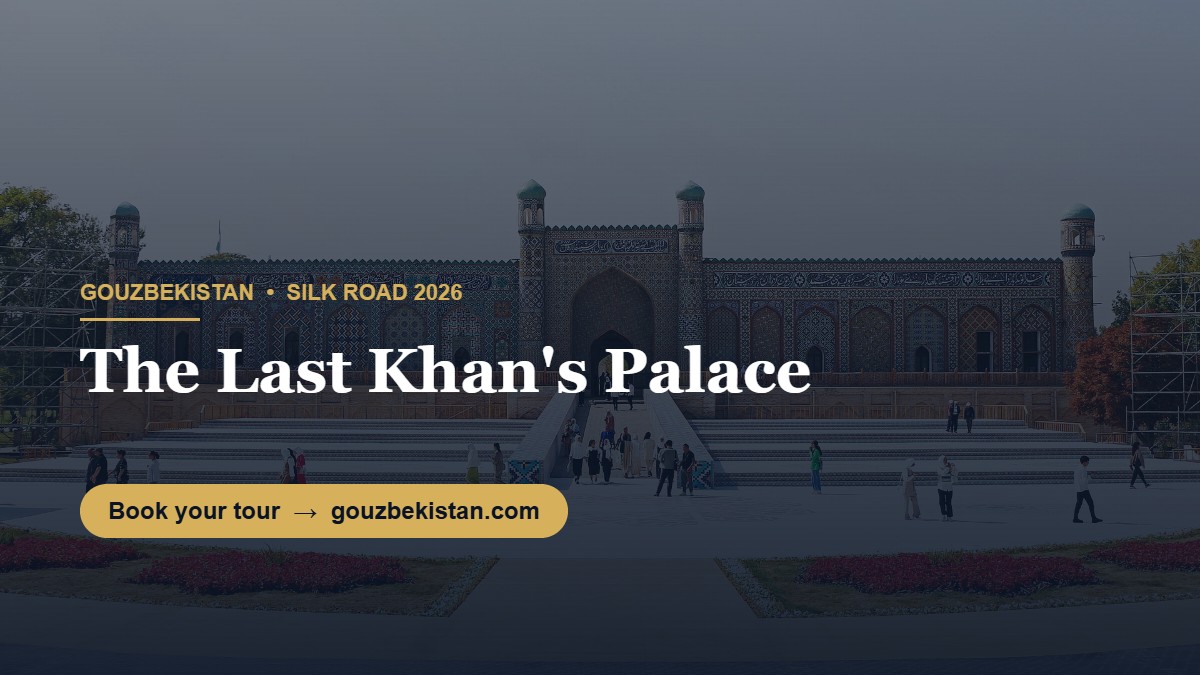
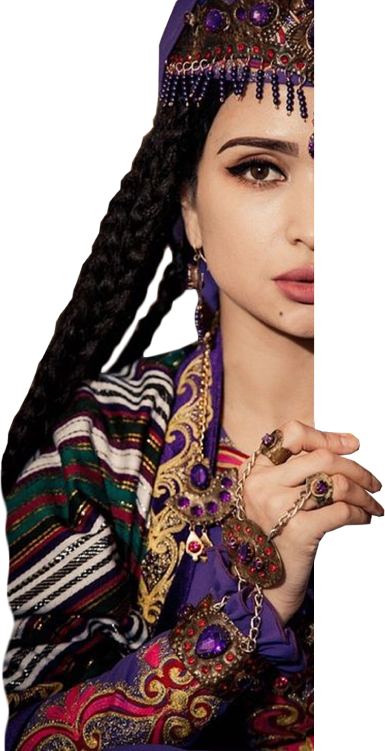
The palace was finished in 1873. It had seven courtyards and 114 rooms, and it ran 138 metres along its front - a wall of blue and white tile so intricate that visitors described it as a carpet turned to stone. Khudayar Khan, ruler of Kokand, had built the last great statement of an independent Central Asian dynasty.
He had three years to enjoy it. Tsarist troops arrived, blew up the fortifications, and in 1876 the Khanate of Kokand ceased to exist.
Five courtyards and nineteen rooms survive. Standing in front of them today, in a quiet provincial city in the Fergana Valley, is one of the strangest and most moving experiences in Uzbekistan - because almost nobody else is there.
Kokand Uzbekistan: a palace built to last, given three years
What remains is enough to break your heart in a good way. The facade is still there, a long band of glazed tile in cobalt, white and ochre, with carved wooden columns and painted ceilings inside that have never been over-restored into blandness. Since 1925 the building has housed the Kokand Museum of Local History, which means you walk through a khan's reception hall and find nineteenth-century saddles, manuscripts and photographs in it - a palace and its own obituary in the same rooms.
It is the most visited attraction in the Fergana Valley, which sounds impressive until you realise how few foreign travellers reach the valley at all. On an autumn weekday you may share the courtyards with a school group and a wedding party photographing the tilework, and that is all.
The Fergana Valley: Uzbekistan's most human landscape
Kokand is the gateway. Behind it lies the greenest, most densely lived-in corner of the country - a bowl of orchards, cotton, mulberry trees and small cities where things are still made by hand rather than displayed.
In Rishtan, potters work the same local clay and the same cobalt and copper glazes their families have used for generations; the blue-and-white bowls stacked in their workshops are the real thing, not souvenirs made for a coach party. In Margilan, silk is still unwound from cocoons, tied, dyed and woven into khan-atlas - the blurred, flame-like ikat that has become the visual signature of Uzbekistan. You can watch every stage in a single morning, and the noise of two hundred wooden looms is something you do not forget.
This is not a museum valley. It is a working one. That is the appeal.
Why French travellers are drawn to Kokand
France has one of the oldest and deepest relationships with Central Asia in Europe, and French travellers tend to arrive in Uzbekistan wanting the thing that is hardest to package: l'authenticité. Not a checklist of three cities, but craft, table, landscape and history taken slowly, with a guide who can explain what a dynasty actually was.
Kokand rewards exactly that instinct. It is a place with a story that has to be told rather than photographed, and the Fergana Valley around it offers the ateliers, the orchards and the family kitchens that make an itinerary feel lived rather than consumed.
The practicalities are simple. French passport holders enter Uzbekistan visa-free for up to 30 days - no consulate appointment, no e-visa. And the classic French departure windows for Central Asia, late September through early November, land precisely in the valley's best weather: 20 to 28 degrees, orchards in fruit, and light that photographers travel for.
How to reach Kokand and the Fergana Valley
The valley used to be the excuse for skipping the region: it sits behind a mountain wall east of Tashkent. That changed with the Kamchik railway tunnel, opened in 2016, which put the Fergana Valley on Uzbekistan's national rail network for the first time. Trains now run from Tashkent through the mountains to Kokand, Fergana and Margilan in a few comfortable hours. By road, the Kamchik Pass itself is one of the finest drives in the country.
Our recommendation: give the valley two nights, not a day trip. Kokand and the palace on the first afternoon, Rishtan and Margilan the following day, and dinner in a family house where the plov is cooked outdoors. Then rejoin the Silk Road classics - the Afrosiyob high-speed train reaches Samarkand from Tashkent in around two hours, and Bukhara in about three and a half to four.
Uzbekistan welcomed close to 7.75 million foreign visitors in the first seven months of 2026, up 22.6% on the year before. The famous cities are getting busier. The valley, for now, is not.
Travel it with a licensed local operator
GoUzbekistan is the travel brand of Lochin Express Plyus LLC, operating in Uzbekistan since 2007 and holding tour operator and domestic tourism licence No. 662280, issued on 13 March 2025 by the Committee for Tourism Development of the Republic of Uzbekistan. We are based in Bukhara and we design every route ourselves, on the ground.
Tell us what you want from Uzbekistan and we will build it. Create your own custom tour, or explore our tours.
Plan your Uzbekistan trip - in your language
العربية
في مدينة قوقند بوادي فرغانة يقف قصر خداير خان، آخر قصور خانات آسيا الوسطى، بجدرانه المزينة بالقاشاني الأزرق. السياحة في أوزبكستان لا تقتصر على سمرقند وبخارى على طريق الحرير. صمّم رحلتك الخاصة إلى أوزبكستان.
Deutsch
In Kokand im Fergana-Tal steht der Palast des letzten Khans: 114 Räume, 1873 vollendet, drei Jahre später gesprengt. Wer eine Seidenstraße Rundreise plant und mehr sehen möchte als Samarkand und Buchara, findet hier das echte Usbekistan. Planen Sie Ihre individuelle Usbekistan Reise oder entdecken Sie unsere Touren.
Español
En Kokand, en el valle de Fergana, sobrevive el palacio del último kan: 114 estancias terminadas en 1873, voladas tres años después. Un viaje a Uzbekistán por la Ruta de la Seda no es solo Samarcanda y Bujará. Diseña tu viaje a Uzbekistán a medida o descubre nuestros circuitos.
Français
À Kokand, dans la vallée de Ferghana, subsiste le palais du dernier khan : 114 pièces achevées en 1873, dynamitées trois ans plus tard. Un voyage en Ouzbékistan sur la Route de la Soie ne se limite pas à Samarcande et Boukhara - ici, la soie et la céramique se font encore à la main. Créez votre voyage sur mesure ou découvrez nos circuits.
中文
在费尔干纳盆地的浩罕,末代汗王的宫殿依然矗立:1873年落成,114个房间,三年后即被摧毁。乌兹别克斯坦旅游不只有撒马尔罕和布哈拉,丝绸之路的深处更有手工陶瓷与丝绸。立即定制您的专属行程,或浏览我们的线路。
Русский
В Коканде, в Ферганской долине, сохранился дворец последнего хана: 114 комнат, достроен в 1873 году и взорван три года спустя. Туры в Узбекистан по Шёлковому пути - это не только Самарканд и Бухара, но и Риштан с Маргиланом, где керамику и шёлк делают вручную. Составьте индивидуальный тур в Узбекистан или посмотрите наши туры.